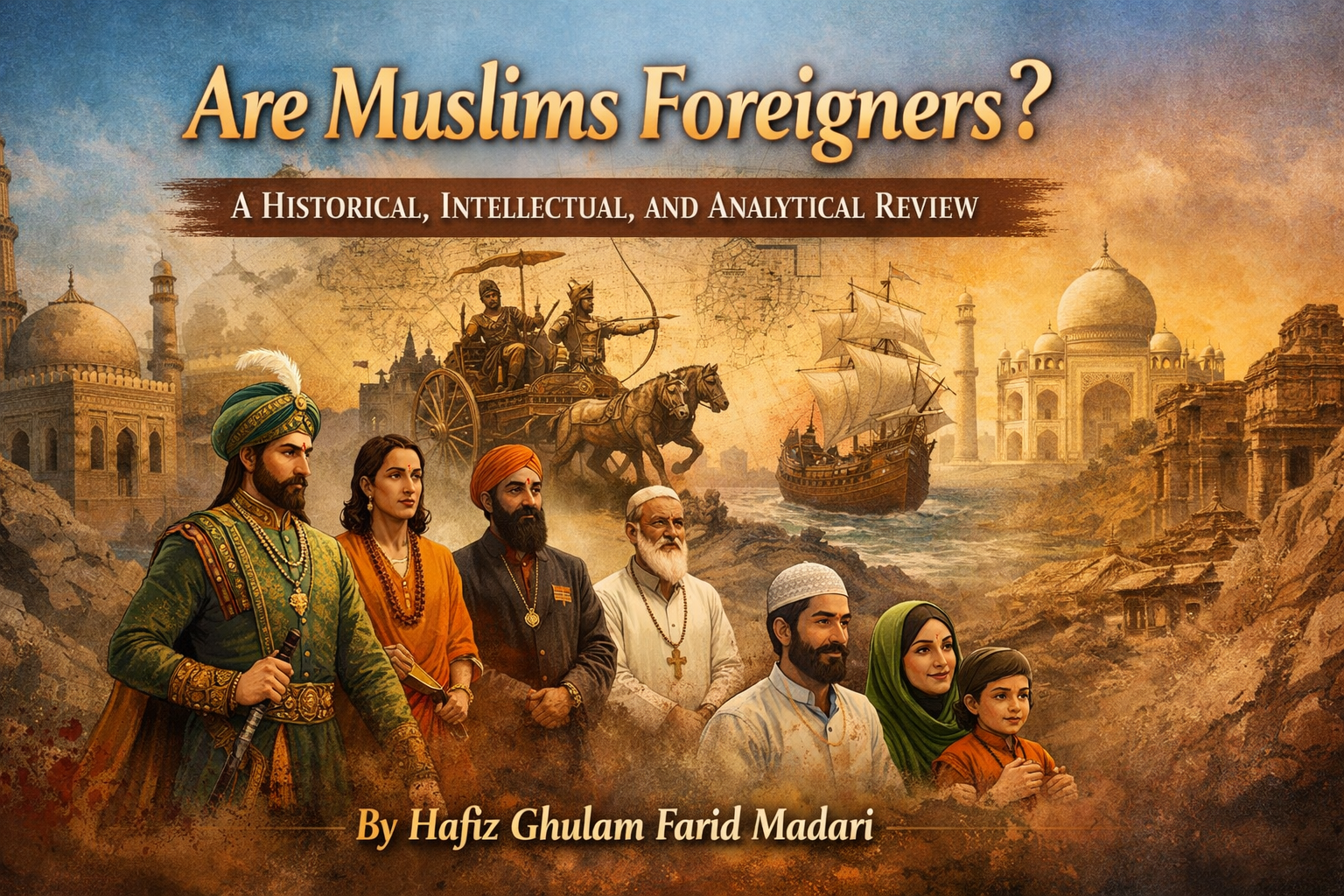
Introductory Remarks
It is often alleged that Muslims are foreigners and that their ancestors came to India from Arab lands. If merely on the basis that someone’s ancestors migrated from outside, their descendants are to be considered foreigners, then Brahmins, Kshatriyas, and Vaishyas in this country would also be regarded as foreigners.
Arrival of the Aryans and Historical Reality
Indian history and Hindu religious texts indicate that the Aryans were not originally inhabitants of India. Rather, they arrived in several waves through land and sea routes and established dominance using strategies commonly described as persuasion, inducement, force, and division.
The Land of Sindh and Its Antiquity
Historical records suggest that this land was settled by Sindh, grandson of Prophet Noah (Sindh, son of Ham, son of Noah, peace be upon him), and a region came to be known by his name, which still exists today.
Thirteen hundred years ago, the region called Sindh was extremely vast. During the reign of Raja Dahir, Sindh extended westward to Makran, southward to the Arabian Sea and Gujarat, eastward to central Malwa, and northward through Multan into southern Punjab. Arab historians referred to this entire region as Sindh.
The region is so ancient that it is difficult to determine when it was first settled or how its name evolved over time. History only tells us that when the Aryans arrived thousands of years ago, they changed the name Sindh to Sindhu, as they used the word “Sindhu” for river in their language. Initially, they called the land Sindhu, but over time the name reverted to Sindh, which remained in use for thousands of years.
Aryan Expansion and Changes in Names
It is said that the Aryans called all territories they conquered Sindh, even after crossing into Punjab, without changing the name. When they reached the banks of the Ganges, they named the region Aryavarta, though this name never gained popularity outside India.
Formation of the Words “Hind” and “India”
Persians pronounced Sindh as “Hind,” and the Greeks altered the pronunciation further, turning it into “Ind.” In Roman usage, this evolved into “Ind,” and later into “India,” since English uses the letter “D” rather than the softer sound used in earlier languages.
(Thus, the land named after Sindh, grandson of Noah, eventually became known as India, while Sindh today refers only to a limited border region.)
Ancient Inhabitants and the Caste System
The ancient inhabitants of the region were known by names such as Dravidians, Nagas, and Asuras. They were subjugated and marginalized, and through the establishment of the caste system, they were categorized as Shudras. Evidence for this can be found in ancient Hindu religious and historical works including:
Rigveda (Volga to Ganga)
Rigvedic Aryans by Rahul Sankrityayan
Discovery of India by Jawaharlal Nehru
Tarikh-e-Ferishta by Muhammad Qasim Ferishta
Gulamgiri by Mahatma Phule
The Doordarshan series “Bharat Ek Khoj”
The book Devasur Sangharsh
And the modern research work “Caste System and Muslims” by Masood Alam Falahi.
Muslim Ancestry and the Land of Hind
The claim that Muslims are foreigners becomes weak when examined through historical research. According to some traditional accounts and Muslim historians, Sindh—later known as Hind—was settled by Sindh, a descendant of Prophet Noah. After that, historical records do not provide definitive evidence about where his descendants went or how their lineage continued. However, it is certain that the population of this region was never limited to one race or religion. Instead, unity and cultural blending were so deep that they are reflected in personalities whose names crossed religious boundaries, such as:
Raghupati Sahay Firaq Gorakhpuri, a Hindu poet whose pen name sounded Muslim; similarly, Ras Khan, Rahim Das, Ram Prasad Bismil, and Kabir Das—names or titles that may appear Muslim, yet belonged to individuals of varied religious affiliations. This shows that names and identities in the subcontinent often transcended religious divisions.
In this connection, the well-known historian Muhammad Qasim Ferishta, in his book Tarikh-e-Ferishta, mentions some local rulers while discussing the descendants of Prophet Noah (peace be upon him), among whom one name that appears is Raja Suraj. It is not clear whether this name existed from the beginning or was adopted later due to religious or cultural changes. However, it is an important fact that examples of names remaining unchanged despite conversion of religion have existed since ancient times. In other words, religious identity may have changed in a certain period, yet family or traditional names often continued.
It is true that in Islam, upon conversion, a good name is often adopted, but in the history of the Indian subcontinent, this process has not always been one-sided. For example, some families embraced Islam but retained their non-Muslim or local names. Even today, in regions of Gujarat, Rajasthan, and Punjab, non-Muslims can be found with names or titles such as Khan or Shah. Similarly, there are families whose ancestors were once associated with Islamic culture or social life, yet after later religious changes, their names or titles resembling Muslim names remained unchanged. This shows that in the subcontinent, names do not always fully represent religious identity; rather, they often reflect culture, geography, family tradition, and social continuity.
Therefore, if a person’s name carries an Islamic tone, it does not necessarily mean that the person or their ancestors were foreigners, nor is it necessary that a name must change immediately after a change in religion. History tells us that people in this region preserved names, customs, languages, and culture separately from religion for centuries. This is why today we find names that appear “Muslim” but belong to individuals of other religions, and likewise, many Muslims bear names linked to local or non-Muslim traditions.
All these realities demonstrate that the identity of the subcontinent is not purely racial or religious but rather a shared cultural and historical one. Therefore, calling Muslims foreigners merely on the basis of names or assumed ancestry, or labeling anyone foreign due to religious identity or religious name, is neither historically accurate nor academically acceptable.
It is possible that when the Aryans attacked regions of Sindh, much bloodshed occurred, and it is also possible that the original inhabitants were killed, migrated elsewhere, or changed their religion.
The Question of Pre-Islamic Mosques
In India, evidence exists of some mosques whose orientation was toward Masjid al-Aqsa. For instance, sites like Charman Pir Dargah are mentioned, and before the sixth century CE, mosques were oriented toward Masjid al-Aqsa. However, how ancient these structures truly are cannot be determined with certainty.
Arrival of the Arabs and Early Campaigns
In 637 CE, Uthman bin Abi al-As al-Thaqafi sent a military expedition toward India. When Caliph Umar (may Allah be pleased with him) learned of this, he reportedly expressed strong displeasure (Tarikh-e-Pak-o-Hind). During the period of Amir Muawiyah, Muhallab bin Abi Sufra is said to have reached Lahore (Tarikh-e-Pak-o-Hind). In 712 CE, Muhammad bin Qasim attacked Raja Dahir of Sindh.
Muslim Rulers and India
Mahmud of Ghazni conducted campaigns, but allegations that he systematically destroyed temples are disputed, and he did not establish permanent rule in India. The foundation of Muslim political rule was later laid through the campaigns of Muhammad Ghori. Many soldiers of subsequent rulers eventually returned to their homelands, while those who remained married Indian women and settled permanently in the region.
The Mughal Era and Economic Prosperity
During the Mughal period, the subcontinent was the world’s second-largest economic power after China. Its share in global industrial production and GDP was about 22 percent, more than the entire share of Europe at the time. According to Western historian Angus Maddison, around 1700 CE, during the reign of Aurangzeb, the subcontinent was the richest region in the world, contributing around 24 percent of global GDP. In the present period (December 2025), India’s share in the global economy stands roughly between 3 and 4 percent. Thus, a region that was once the world’s largest economic power is now considered a middle-level global economy. This is presented as a response to historians who describe Muslims solely as plunderers or occupiers. Some non-Muslim historians, such as Lax Varma, have described the Mughal Empire as an industrial and technologically advanced state.
Conclusion: Muslims Are Not Foreigners
Throughout the Muslim period, many people accepted Islam due to social dignity and brotherhood, including individuals from higher social castes. Even if it is assumed that some Muslims migrated from outside, their numbers were relatively small. The majority consisted of local inhabitants who embraced Islam after witnessing its moral teachings and principles of equality.
Therefore, labeling Muslims as foreigners is entirely incorrect. In independent India, every citizen of the country is Indian, whether Brahmin or Shudra, Muslim, Sikh, Christian, or belonging to any other community. If Muslims are called foreigners on the basis of prejudice, then historically the Aryans would also need to be considered foreigners. As the saying goes, those who live in glass houses should not throw stones at others.
In preparing this article, reference was made to numerous authentic writings, especially the work of Ram Saran Pawan Ji.
Written by: Hafiz Ghulam Farid Madari