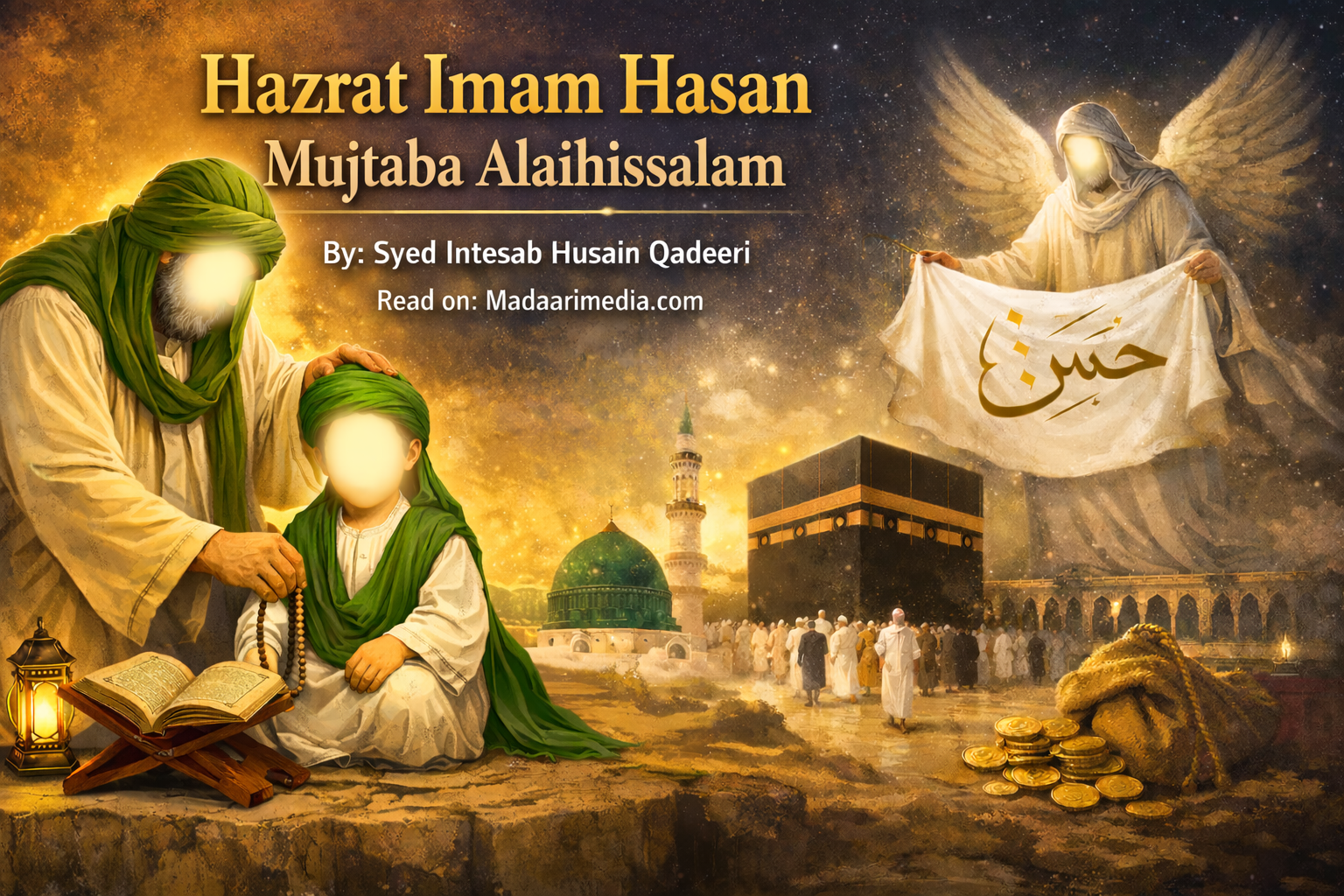
- Hazrat Imam Hasan
- Imam Hasan Mujtaba
- Biography of Imam Hasan
- Life of Imam Hasan
- Virtues of Imam Hasan
- Generosity of Imam Hasan
- Knowledge of Imam Hasan
- Imam Hasan Peace Treaty
- Martyrdom of Imam Hasan
- Grandson of Prophet Muhammad
- Seerat Imam Hasan
- Son of Hazrat Ali
A Short Article on the Blessed Birth of Ameer-ul-Mu’mineen Imam Hasan
(On the Occasion of 15th Ramadan)
Just as Allah, the Lord of the worlds, transforms barren and uncultivable land into flourishing gardens by sending rain from the vast canopy of the sky—placing large and small clouds upon the delicate shoulders of the heavens and loading them with water to quench the thirst of the needy earth—so too, in a similar manner, the spiritual barrenness of the Muslim Ummah is revived through the blessed rain of the spiritual grace of the Messenger of Allah ﷺ.
For this purpose, the noble descendants of the Prophet (the Ahl al-Bayt) are like sacred clouds—large and small—that continually shower blessings upon the Ummah. Through the rain of the Prophet’s spiritual grace, they transform the hearts of believers into flourishing gardens.
The presence of these blessed souls provides protection from the scorching sun of despair and disappointment. Among this pure assembly stands a noble and courageous personality—an embodiment of bravery and heroism, yet crowned with patience and forbearance.
He is the one who adorns the turban of the Ummah with a plume of honor, spreading rays of truth across the skies of sincerity. His green banners of dignity flutter upon the fortresses of justice in Islam. He sails the shining waters of generosity with the vessel of his greatness and power, and plants the flags of courage in the vast fields of bravery.
Patient, gentle-natured, noble-hearted, humble in temperament, the generous one of the Ahl al-Bayt—
the pearls and corals of the ocean of purity and sainthood,
the sea of spiritual knowledge,
the leader of mankind and jinn,
the most refined flower of the garden of character,
the beloved grandson of Lady Fatimah and the fragrant flower of the Messenger of Allah ﷺ—
He is Ameer-ul-Mu’mineen, Sayyiduna Imam Hasan al-Mujtaba (peace be upon him).
He is not some lost treasure whose identity needs to be introduced. Rather, he is a priceless jewel from the treasury of the Prophet ﷺ and the radiant sun of the sky of Imamate—whose like cannot be found anywhere in the universe.
This entire universe—from the gentle breezes of the wind to the waves of the tsunami, from the dew drops on flower petals to the torrents that split the earth with floods, from the flickering lamps of dawn to the sun that circles the vast heavens, from the streams of valleys to the roaring seas, from flowing waves to falling rain, from the narrowness of the earth to the vastness of the skies, from the clusters of galaxies to the gatherings of stars, from the heights of the Pleiades to the elegance of flowers—
all fall under the influence and excellence of this unique personality, who has been granted leadership in both this world and the Hereafter.
Blessed Name and Titles
Name: Hasan
Kunyah: Abu Muhammad
Titles:
Seal of the Rightly Guided Caliphate,
Generous of the Ahl al-Bayt,
Al-Taqi, Al-Naqi, Al-Jawad, Al-Zaki,
Al-Sayyid, Al-Halim, Al-Salim, Al-Karim,
The Humble One, Leader of the Youth of Paradise,
Grandson of the Messenger, Al-Mujtaba,
Resembling the Prophet, Fragrance of the Prophet.
Noble Lineage
Imam Hasan al-Mujtaba ibn Ali al-Murtada ibn Abi Talib ibn Abdul Muttalib ibn Hashim
Blessed Birth
Imam Hasan was born on Tuesday, the 15th of Ramadan, 3 AH (February 625 CE) in the blessed city of Madinah al-Munawwarah, becoming a source of beauty and joy for the gardens of the sacred city.
When the good news reached the Messenger of Allah ﷺ that a child had been born in the house of Sayyidah Fatimah, the joy of the Prophet cannot truly be described. The happiness of the entire universe was on one side, and the smile of the Prophet ﷺ on the other.
Filled with joy, the Prophet ﷺ came and lifted the blessed child into his arms. The newborn opened his eyes and first saw the face that even the angels long to behold.
The Prophet ﷺ recited the Adhan in his right ear and the Iqamah in his left ear, and placed his blessed saliva in the child’s mouth as a sacred blessing.
Praise from Abdullah ibn Zubayr (RA)
Hazrat Abdullah ibn Zubayr (RA) used to say:
“By Allah, no woman has ever given birth to a child like Hasan ibn Ali.”
(Al-Bidayah wa al-Nihayah)
Imam Hasan (RA) was humble, patient, reliant upon Allah, and dignified. He remained constantly engaged in ascetic worship and spiritual struggle.
The Seal of the Rightly Guided Caliphate
According to the statement of the Messenger of Allah ﷺ, Imam Hasan was the last of the Rightly Guided Caliphs. His devotion in prayer reached the highest levels of humility and concentration.
He performed twenty-five pilgrimages (Hajj) on foot, even though in his stables were noble horses and at his door stood valuable camels.
Generosity
Imam Hasan al-Mujtaba was the most generous person of his time. Because of his extraordinary generosity, he was called “Karim Ahl al-Bayt” (The Most Generous of the Prophet’s Family).
He was the embodiment of generosity and benevolence.
The great scholar Imam Ibn al-Jawzi (d. 654 AH) writes in Tadhkirat al-Khawas that Imam Hasan twice gave away all of his wealth in the path of Allah and on three occasions divided all his possessions equally among the poor.
Once, when a needy person requested assistance, he gave him twenty thousand dirhams.
Caring for orphans, the poor, and widows was one of his main concerns.
Virtues and Excellence
Numerous hadiths mention the virtues and noble qualities of Imam Hasan (RA).
Glad Tidings Before His Birth
The aunt of the Prophet ﷺ, Sayyidah Umm al-Fadl (RA), once narrated a dream to the Messenger of Allah ﷺ:
“O Messenger of Allah! I saw a part of your blessed body come into my house.”
The Prophet ﷺ replied:
“You have seen a good dream. A son will soon be born to Fatimah, and you will nurse him.”
When Imam Hasan was born, Umm al-Fadl indeed had the honor of nursing him.
(Al-Dhariyyah al-Tahirah)
None Like You
Hazrat Abdullah ibn Zubayr (RA) used to express great love for the grandson of the Prophet ﷺ. On one occasion he said:
“By Allah, no woman has given birth to a son like Hasan ibn Ali.”
(Subul al-Huda)
The Messenger of Allah ﷺ loved Imam Hasan deeply. Sometimes he would carry him lovingly in his arms, and sometimes he would place him upon his blessed shoulders.
At times the Prophet ﷺ would visit the house of Sayyidah Fatimah just to see and kiss him.
Imam Hasan (RA) also became deeply attached to the Prophet ﷺ and would even climb onto his blessed back during prayer.
Riding on the Shoulders of the Prophet
Once the Prophet ﷺ had Imam Hasan on his shoulders. A man remarked:
“O boy! What a wonderful ride you have!”
The Prophet ﷺ replied:
“And he is also a wonderful rider.”
(Tirmidhi)
Tears of Love
Hazrat Abu Hurairah (RA) said:
Whenever I saw Imam Hasan, tears would flow from my eyes.
He narrated that once the Prophet ﷺ came to the mosque, held his hand, and walked with him until they reached the market of Banu Qaynuqa. When they returned, the Prophet ﷺ asked:
“Where is the little boy? Bring him to me.”
Imam Hasan came and sat in the Prophet’s lap. The Prophet ﷺ placed his blessed tongue in the child’s mouth and prayed:
“O Allah, I love him, so love him and love those who love him.”
(Al-Adab al-Mufrad)
Knowledge Without Limit
Imam Hasan (AS) possessed divinely granted knowledge (Ilm-e-Ladunni). He did not require worldly schools or institutions for learning. His school was the blessed company of his grandfather, the Messenger of Allah ﷺ.
Because of this, even in childhood he possessed knowledge that ordinary scholars could not attain even in old age.
His knowledge and excellence were directly derived from the blessings of Prophethood.
Historians such as Ibn Sa’d, Baladhuri, and Ibn Asakir report that Imam Hasan used to perform the Fajr prayer in Masjid al-Nabawi and remain engaged in worship until sunrise. Afterwards, scholars would gather around him for discussion and learning. The same practice continued after the Zuhr prayer as well.
He would sit in Masjid al-Nabawi while people formed circles around him and asked questions on various topics, to which he would provide answers.
(Al-Fusul al-Muhimmah)
Knowledge Without Limit
Allama Ibn Talha al-Shafi‘i, quoting Tafsir Wahidi, writes that a man once asked Abdullah ibn Abbas and Abdullah ibn Umar (RA) about the meaning of the Qur’anic words “Shahid” (Witness) and “Mashhood” (That which is witnessed).
Ibn Abbas (RA) said that “Shahid” refers to Friday (Yawm al-Jumu‘ah) and “Mashhood refers to the Day of ‘Arafah.”
Ibn Umar (RA) said that “Shahid” refers to Friday and “Mashhood refers to the Day of Sacrifice (Yawm al-Nahr).
After hearing their explanations, the man went to Imam Hasan (AS) and asked the same question.
Imam Hasan replied that “Shahid refers to the Messenger of Allah ﷺ and “Mashhood refers to the Day of Judgment.”
As evidence he recited the verses:
“O Prophet! Indeed We have sent you as a witness, a bearer of good tidings and a warner.”
(Qur’an)
and
“That is the Day when all mankind will be gathered together, and that is the Day which will be witnessed.”
After hearing all the answers, the questioner said:
“The statement of Hasan is the best among them.”
(Matalib al-Su’ul, p.235)
The Status of Mujtaba on the Shoulders of Mustafa ﷺ
Hazrat Bara bin ‘Azib (RA) narrates that he saw the Messenger of Allah ﷺ carrying Imam Hasan (RA) on his shoulders and praying:
“O Allah! I love him, so love him as well.”
(Sahih Bukhari)
Caliphate and the Great Reconciliation
After the martyrdom of Ali ibn Abi Talib (RA) in Ramadan 40 AH, the Muslims pledged allegiance to Imam Hasan (RA).
When the governor of Syria, Amir Muawiyah (RA), heard about this, he prepared an army and marched toward Iraq.
When Imam Hasan learned that an army was advancing from Syria, he also set out with a force for defense and camped at Madain.
Some soldiers thought that Imam Hasan did not intend to fight. When they asked him about it, he replied:
“The unity of Muslims, their welfare, the protection of their lives and property, and reconciliation among them are most beloved to me.”
Because of these statements, disagreements arose within his army. However, Imam Hasan possessed great dignity and extraordinary patience. Pride and emotional impulsiveness had no place in his character.
Therefore, he made peace with Amir Muawiyah (RA) and stepped down from the caliphate, saving the lives of thousands of Muslims.
In this way he fulfilled the prophecy of his grandfather, the Messenger of Allah ﷺ, who said:
“This son of mine is a leader. Through him Allah will reconcile two great groups of Muslims.”
(Sahih Bukhari – Hadith 2704)
When he relinquished the caliphate, some people criticized him saying:
“O disgrace of the Muslims!”
Imam Hasan immediately replied:
“Disgrace is better than the Fire (of Hell).”
These words contain a great lesson for the leaders of the Muslim Ummah today. Power struggles often result in the bloodshed of countless Muslims. Disunity has weakened the Ummah, and cunning enemies exploit this division.
If only the rulers of the Muslim world would follow the example of Imam Hasan’s character, promoting unity and peace.
Respect for the Family of the Prophet
The Tabi‘i scholar Abu al-Hawari (RA) narrates that he asked Imam Hasan:
“Do you remember any hadith from the Messenger of Allah ﷺ?”
Imam Hasan replied:
“Yes. When I was a child, I once took a date from the charity dates and put it into my mouth. My grandfather, the Messenger of Allah ﷺ, removed the date from my mouth and placed it back among the charity dates.”
Someone said:
“O Messenger of Allah, what harm is there if he eats just one date?”
The Prophet ﷺ replied:
“Indeed, charity is not lawful for the family of Muhammad.”
(Asad al-Ghabah)
Noble Character and Sweet Speech
Ibn Sa‘d narrates that Imam Hasan’s speech was so gentle and pleasant that when he spoke to someone, the listener wished the conversation would never end.
It is also said:
No indecent or offensive words were ever heard from his tongue.
(Tarikh al-Khulafa)
Patience and Forbearance
His tolerance was so great that even when extremists insulted him to his face, he would not respond harshly. Sometimes he would even offer them food.
Despite possessing strength and power, he would not seek revenge—this was a noble inheritance from his father Ali al-Murtada (RA).
He was extremely courageous; the battles of Siffin and Nahrawan testify to his bravery.
He inherited the virtues and excellence of the Messenger of Allah ﷺ. Even with great strength and authority, he remained a symbol of patience, humility, and contentment.
In peace he was a model of mercy and love, and in battle a brave warrior.
A Miracle
Although many miracles are attributed to him, one example is mentioned here briefly.
Fresh Dates from a Dry Tree
The famous scholar Nuruddin Abdur Rahman Jami narrates that during a journey Imam Hasan once passed through a date orchard where all the trees had dried up.
Abdullah ibn Zubayr (RA) was traveling with him. They camped there, and a bedding was laid beneath a dry tree.
Ibn Zubayr said:
“O grandson of the Messenger of Allah! If only this dry tree had fresh dates so that we could eat them.”
Imam Hasan quietly recited a supplication. Within moments, the dried tree became green and fresh dates appeared upon it.
Seeing this, a camel driver exclaimed that it must be magic.
Ibn Zubayr rebuked him and said:
“This is not magic. It is the accepted supplication of the grandson of the Messenger of Allah.”
The people then ate the dates from the tree.
(Shawahid al-Nubuwwah)
The Story of the Cobbler’s Love
During the time when Imam Hasan had brought reconciliation among Muslims, he was invited by rulers in Persia.
When people heard that the grandson of the Messenger of Allah ﷺ was coming, crowds gathered with expensive gifts.
Among them was a poor cobbler who had nothing to offer. He wept in sorrow.
His wife told him:
“You are a cobbler. Make the best pair of sandals you can and present them as a gift.”
He worked the entire night and made a beautiful pair of sandals.
When he reached the gathering, people pushed him aside because of his poverty.
But Imam Hasan noticed him, called him forward, and said:
“In our court, wealth is not valued—intentions are valued.”
The cobbler offered the sandals with tears in his eyes.
Imam Hasan gave him five thousand coins that had been gifted by the king.
Then he said:
“Go, I give you the glad tidings of Paradise.”
He also said:
“Give this glad tidings to your wife as well, for she too will enter Paradise.”
The crowd was astonished at the honor given to the poor man.
The Great Martyrdom
The exact date of Imam Hasan’s martyrdom differs among historians, but the most widely accepted opinion is 28 Safar 49 AH.
He was poisoned. The poison was administered three times, and the final dose was so severe that his intestines began to rupture.
Historians could not conclusively determine who administered the poison.
His funeral prayer was led by Sa‘id ibn al-‘As (RA), who was the governor of Madinah at the time.
Imam Husayn (RA) brought the body forward for the prayer.
The crowd at his funeral was so large that if a needle had been dropped, it would have landed on someone’s head rather than the ground.
He was buried in Jannat al-Baqi beside his blessed mother.