What is Ghadir Khumm?
Khumm is the name of a place where a large number of dense trees were found. It is located three miles from Juhfah (a place situated between Makkah al-Mukarramah and Madinah al-Munawwarah). Near this valley of Juhfah is the famous Ghadir (pond), which is also attributed to Khumm.
(Mirqat al-Mafatih Sharh Mishkat al-Masabih, Bab Manaqib Ali ibn Abi Talib, Al-Fasl al-Thalith, 10/475, Hadith: 6103)
At this very place, the Noble Prophet صَلَّی اللّٰہُ تَعَالٰی عَلَیہ وَاٰلہٖ وَسَلَّم proclaimed regarding Sayyiduna Ali al-Murtada کَرَّمَ اللّٰہُ تَعَالٰی وَجْھَہُ الکَرِیم:
“مَن کُنتُ مَولاَہُ فَعَلِیٌّ مَولَاہُ”
meaning, “Whoever has me as his Mawla, Ali is also his Mawla.” In other words, the Holy Prophet ﷺ publicly announced the lofty rank and authority of the Wilayah of Mawla Ali.
Eid al-Ghadir and the Proclamation of the Wilayah of Ali
In Islamic history, Eid al-Ghadir is a very significant day. It is the very day on which the religion of Islam was completed. The religion of Islam that continued from Sayyiduna Adam عليه السلام until the Holy Prophet ﷺ remained incomplete until 9 AH and was completed in the field of Ghadir in 10 AH.
As mentioned by Allama Jalal al-Din al-Suyuti in “الدر المنثور في التفسير بالمأثور” (2:259) regarding the occasion of revelation of the verse:
اَلۡیَوۡمَ اَکۡمَلۡتُ لَکُمۡ دِیۡنَکُمۡ
“Today I have perfected your religion for you.”
He writes that when the Holy Prophet ﷺ proclaimed on the day of Ghadir Khumm, “من کنت مولاہ فعلی مولاہ”, this noble verse was revealed.
[السیف الجلی علی منکر ولایت علی (اعلان غدیر) ص، 46]
It is narrated that when the Holy Prophet ﷺ had completed his final pilgrimage, known as Hajjat al-Wada’, and was returning toward Madinah al-Munawwarah accompanied by more than one hundred thousand Companions, he halted at a desert area between Makkah and Madinah known as Ghadir Khumm. As preparations were being made to continue the journey, Sayyiduna Jibril عليه السلام descended with the following noble verse:
یٰۤاَیُّهَا الرَّسُوْلُ بَلِّغْ مَاۤ اُنْزِلَ اِلَیْكَ مِنْ رَّبِّكَؕ-وَ اِنْ لَّمْ تَفْعَلْ فَمَا بَلَّغْتَ رِسَالَتَهٗؕ-وَ اللّٰهُ یَعْصِمُكَ مِنَ النَّاسِؕ (سوره مائده)
“O Beloved Prophet ﷺ! Convey that which has been revealed to you from your Lord. If you do not do so, then you have not conveyed His message. And Allah will protect you from the people.”
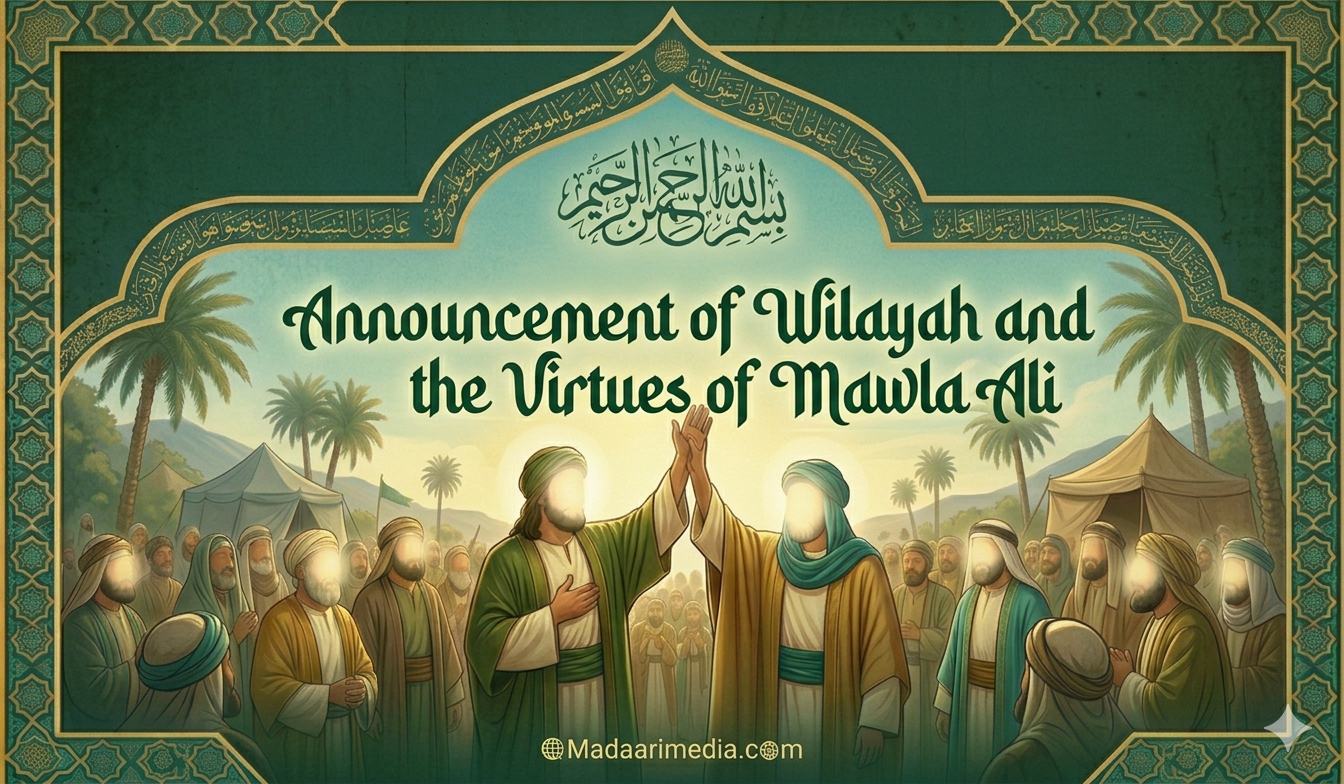
Thereafter, the Holy Prophet ﷺ gathered all the Companions. Those who had already departed were called back, and those who had remained behind were awaited. When everyone had assembled, the Prophet ﷺ instructed that camel saddles be stacked one upon another to form a pulpit. Seventy (70) saddles were arranged, and the pulpit of Wilayah was prepared. The Holy Prophet ﷺ then stood near this pulpit. It was midday, the plain of Ghadir was silent, and the heat was intense.
Zayd ibn Arqam narrates that we arrived at Ghadir Khumm along with the Messenger of Allah ﷺ. Then a caller proclaimed: “الصلاة جامعة”. The ground beneath the trees was cleared for the Messenger of Allah ﷺ. After the Zuhr prayer, the Messenger of Allah ﷺ took the hand of Ali ibn Abi Talib and addressed the people, saying: “O people! Do you not know that I have greater authority over the believers than they have over themselves?” They all replied, “Indeed.” Then he said: “Do you not know that I have greater authority over every believer than he has over himself?” They replied, “Yes indeed, O Messenger of Allah ﷺ! You have greater authority over every believer than he has over himself.” Thereupon he declared: “Whoever has me as his Mawla, Ali is also his Mawla. O Allah! Befriend the one who befriends Ali and be the enemy of the one who is hostile to Ali.” After this, Sayyiduna Umar met Sayyiduna Ali and said: “Congratulations to you, O Ali ibn Abi Talib! Today you have become the Mawla of me and of every believing man and woman.”
It is narrated that after the pulpit had been prepared, the Holy Prophet ﷺ first praised and glorified Allah Almighty. Then he brought Mawla al-Ka’inat onto the pulpit of Wilayah and raised him with both hands so high that light appeared from beneath his blessed arms. The reason for raising Mawla al-Ka’inat publicly was so that no one could later claim that they had neither seen nor heard. The voice of the Holy Prophet ﷺ was reaching equally in all directions and all the Companions were listening attentively. He then said: “O people! Soon I shall depart from this world. Until now I have been your Wali, but after me Ali will be your Wali. Hold firmly to him and you will never go astray.” He also instructed those present to convey this message to those who were absent.
Sayyiduna Abdullah ibn Abbas said: “By Allah! This matter, namely accepting Ali as one’s Wali, has become obligatory upon the entire community.”
[Nasa’i, Ibn Mardawayh]
After the proclamation of Mawlayah, Sayyiduna Umar Faruq al-Azam رضي الله عنه submitted: “Congratulations, congratulations, O Ali! Today you have entered the morning in such a state that you have become the Mawla of us and of all believing men and women.” Thereafter, Sayyiduna Abu Bakr al-Siddiq رضي الله عنه, Sayyiduna Uthman Ghani رضي الله عنه, the other noble Companions, and then one after another the Mothers of the Believers offered their congratulations.
Some people accepted Ali as Mawla, while others rejected him there and then, such as Harith Fahri. Some people rejected this declaration later on as well, and Divine punishment descended upon them.
As Imam Muhammad ibn Ahmad al-Qurtubi has also transmitted regarding the first verse of Surah al-Ma‘arij, ﴿سَأَلَ سَائِلٌ بِعَذَابٍ وَاقِعٍ﴾, the questioner referred to Harith ibn Nu‘man al-Fihri. The reason was that when he heard the Prophet’s statement regarding Sayyiduna Ali, the Lion of Allah:
“مَنْ كُنتُ مولاه فعلی مولاه”
he mounted his she-camel and came until he reached Abtah. There he said: “O Muhammad ﷺ! You commanded us concerning Allah Almighty that we should testify that ‘La ilaha illa Allah’ and that ‘you are the Messenger of Allah,’ and we accepted that from you. You commanded us to perform the five daily prayers, and we accepted that. You commanded us to pay Zakah from our wealth, and we accepted that. You commanded us to fast during Ramadan every year, and we accepted that. You commanded us to perform Hajj, and we accepted that. Yet you were still not satisfied until you gave superiority to your cousin (Ali) over us. Is this something from yourself or from Allah Almighty?”
The Holy Prophet ﷺ replied: “By the One besides Whom there is no deity, this is from Allah Almighty.”
Harith then turned away saying: “O Allah! If what Muhammad ﷺ says is true, then rain stones upon us from the sky or bring upon us a painful punishment.”
By Allah! He had not even reached his she-camel when Allah Almighty struck him with a stone that hit his head and passed through his body, killing him. Thereupon the following verse was revealed:
﴿سَأَلَ سَائِلٌ بِعَذَابٍ وَاقِعٍ﴾
[Book: Tafsir al-Qurtubi, Volume 9, p. 588]
Then Sayyiduna Jibril عليه السلام descended with the following noble verse:
اَلْیَوْمَ اَكْمَلْتُ لَكُمْ دِیْنَكُمْ وَ اَتْمَمْتُ عَلَیْكُمْ نِعْمَتِیْ وَ رَضِیْتُ لَكُمُ الْاِسْلَامَ دِیْنًا
“O My Beloved! Today I have perfected the religion of Islam for you, completed My blessings upon you, and chosen Islam as your religion.”
(صواعق محرقہ)
It is narrated from Sayyiduna Ali al-Murtada کَرَّمَ اللّٰہ تَعَالٰی وَجْھَہُ الکَرِیم that the Messenger of Allah صَلَّی اللّٰہ تَعَالٰی عَلَیہ وَاٰلہٖ وَسَلَّم tied a turban upon my head on the Day of Ghadir Khumm and allowed its tail to hang down my back.
[سنن الکبری للبیہقی، کتاب السبق والرمی، باب التحریض علی الرمی، ۱۰/۲۴، حدیث: ۱۹۷۳۶]
اَلۡیَوۡمَ اَکۡمَلۡتُ لَکُمۡ دِیۡنَکُمۡ
“Today I have perfected your religion for you.”
Regarding the occasion of revelation of this verse, the scholars of Hadith and Tafsir have also narrated the following blessed tradition:
Sayyiduna Abu Hurayrah رضي الله عنه narrates that whoever fasts on the 18th of Dhu al-Hijjah will be granted the reward of sixty months of fasting. This was the Day of Ghadir Khumm, when the Holy Prophet ﷺ took the hand of Sayyiduna Ali and said: “Am I not the guardian of the believers?” They replied: “Certainly, O Messenger of Allah!” The Prophet ﷺ then declared: “Whoever has me as his Mawla, Ali is his Mawla.” Upon this, Sayyiduna Umar ibn al-Khattab رضي الله عنه said: “Congratulations, O son of Abu Talib! You have become the Mawla of me and of every Muslim.” At that moment Allah Almighty revealed the verse:
﴿الْيَوْمَ أَكْمَلْتُ لَكُمْ دِينَكُمْ﴾
“Today I have perfected your religion for you.”
Zayd ibn Arqam رضي الله عنه narrates that when the Messenger of Allah ﷺ returned from Hajjat al-Wada’, he stopped at Ghadir Khumm. The Prophet ﷺ ordered that a canopy be erected, and it was set up. Then he said:
“It seems that soon I shall receive the call (of departure from this world), and I will answer it. Indeed, I am leaving among you two weighty matters, each greater in importance than the other: one is the Book of Allah and the other is my family (Ahl al-Bayt). Therefore, be mindful of how you deal with these two after me. They shall never separate from one another until they come to me at the Pond of Kawthar.”
Then he said:
“Indeed Allah is my Mawla, and I am the Mawla of every believer.”
Then he took the hand of Sayyiduna Ali رضي الله عنه and declared:
“Whomever I am his Mawla, this Ali is his Wali. O Allah! Love the one who loves him and show enmity to the one who shows enmity towards him.”
[نسائي، السنن الکبری، 5 : 45، 130، رقم : 8148، 8464]
Tariq ibn Shihab narrates that a Jew came to Sayyiduna Umar رضي الله عنه and said:
“O Commander of the Believers! There is a verse in your Book which, had it been revealed to us Jews, we would have made the day of its revelation a festival.”
Sayyiduna Umar رضي الله عنه asked:
“Which verse is that?”
He replied:
{الْیَوْمَ أَكْمَلْتُ لَكُمْ دِینَكُمْ وَأَتْمَمْتُ عَلَیْكُمْ نِعْمَتِی}
“Today I have perfected your religion for you and completed My favor upon you.”
Sayyiduna Umar رضي الله عنه replied:
“By Allah! I know the very day on which this verse was revealed to the Messenger of Allah ﷺ. In fact, I even know the exact time at which it was revealed. It was on a Friday and during the evening of Arafah.”
[الفتح الربانی / تفسير من سورة النساء إلى سورة الأعراف / حدیث: 8578]
Ahmad narrates from Abu al-Tufayl that once Sayyiduna Ali رضي الله عنه gathered people in a spacious place and said:
“I adjure you by Allah and ask you to tell me what the Messenger of Allah ﷺ said regarding me on the Day of Ghadir Khumm.”
At this gathering, thirty (30) men stood up and testified:
“We bear witness that in our presence the Messenger of Allah ﷺ said:
‘Whomever I am his Mawla, Ali is also his Mawla. O Allah! Love the one who loves Ali and be the enemy of the one who bears enmity toward Ali.’”
(تاریخ الخلفاء)
Virtues of Mawla Ali Karramallahu Wajhah
In the chapter on Wilayah, consider the words of Shah Waliullah Muhaddith Dehlawi رحمة الله عليه:
و فاتحِ اوّل ازین اُمت مرحومہ حضرت علی مرتضی است کرم اللہ تعالیٰ وجھہ۔ و سرِ حضرت امیر کرم اللہ وجھہ در اولادِ کرام ایشان رضی اللہ عنہم سرایت کرد۔چنانکہ کسی از اولیاء امت نیست الا بخاندانِ حضرت مرتضیٰ رضی اللہ عنہ مرتبط است بوجہی از وجوہ۔
“In this blessed Ummah, the first person to open the door of Wilayah was Hazrat Ali al-Murtada رضي الله عنه. The secret of Wilayah possessed by Hazrat Amir رضي الله عنه was transmitted into his noble descendants. Thus, there is not a single saint among the Awliya of this Ummah who is not connected in some way to the family of Hazrat Ali رضي الله عنه for the acquisition of spiritual sainthood.”
و از اُمتِ آنحضرت ﷺ اوّل کسیکہ فاتحِ بابِ جذب شدہ است، و دراں جا قدم نہادہ است حضرت امیر المؤمنین علی کرم اللہ وجھہ، و لہٰذا سلاسلِ طُرُق بداں جانب راجع میشوند۔
“In the Ummah of the Holy Prophet ﷺ, the first person who became the conqueror of the highest and strongest path of spiritual attraction (Jazb), and the first to step upon that lofty station, was Amir al-Mu’minin Hazrat Ali رضي الله عنه. Therefore, the various chains of spirituality and sainthood ultimately trace back to him.”
For this reason, Shah Waliullah Muhaddith Dehlawi رحمة الله عليه writes:
“Whoever in this Ummah receives the spiritual grace of Wilayah from the court of the Messenger ﷺ receives it either through the connection of Ali al-Murtada رضي الله عنه or through the connection of Ghawth al-Azam Jilani رضي الله عنه. Without this, no person can attain the rank of Wilayah.”
[السیف الجلی علی منکر ولایت علی (اعلان غدیر) ص، ۱۰]
From the book “تاریخ الخلفاء” of Allama Jalal al-Din al-Suyuti, a few virtues of Mawla Ali:
Imam Ahmad states that no other Companion has had as many narrations reported regarding his virtues as have been reported concerning Hazrat Ali رضي الله تعالى عنه.
It is narrated in Bukhari and Muslim from Hazrat Sa‘d ibn Abi Waqqas that during the expedition of Tabuk, when the Messenger of Allah ﷺ instructed Hazrat Ali to remain in Madinah and did not take him with the other warriors, Hazrat Ali said: “O Messenger of Allah ﷺ! Are you leaving me behind as your deputy over the women and children?” The Holy Prophet ﷺ replied: “Are you not pleased that your position to me is like the position of Harun عليه السلام to Musa عليه السلام, except that there will be no prophet after me?”
Bukhari and Muslim narrate from Sahl ibn Sa‘d that during the campaign of Khaybar, the Messenger of Allah ﷺ said one day: “Tomorrow I shall give the banner of Islam to a man at whose hands, if Allah wills, Khaybar shall be conquered. He loves Allah and His Messenger, and Allah and His Messenger love him.” That night people remained engaged in discussion, wondering who would be given the banner the next morning. When morning came, every person presented himself before the Messenger of Allah ﷺ, each hoping that he would be granted that honour. When all the Companions had gathered, the Prophet ﷺ asked: “Where is Ali?” The Companions replied that he was suffering from an eye ailment and therefore had not come. The Prophet ﷺ said: “Bring him to me immediately.” When Hazrat Ali arrived, the Prophet ﷺ applied his blessed saliva to his eyes, and they were instantly cured (and never troubled him again throughout his life). Thereafter, the Messenger of Allah ﷺ entrusted the military banner to him, while the rest of us remained astonished.
In Sahih Muslim, it is narrated from Sa‘d ibn Abi Waqqas that when the verse of Mubahalah was revealed:
فدع ابناءنا وا بناءکم
The Messenger of Allah ﷺ called Hazrat Aliؑ, Hazrat Fatimah al-Zahraؐ, Hazrat Hasanؑ, and Hazrat Husaynؑ and supplicated:
“O Allah! These are the people of my household.”
The Command to Love Hazrat Ali رضي الله عنه
Tirmidhi and Hakim narrate on the authority of Buraydah that the Messenger of Allah ﷺ said:
“Allah Almighty has commanded me to love four men, and I have also been informed that Allah Almighty loves them.”
The people said:
“O Messenger of Allah! Tell us their names.”
The Prophet ﷺ replied:
“One of them is Ali.”
Regarding the remaining three, it is said that they were Hazrat Abu Dharr, Hazrat Miqdad, and Hazrat Salman al-Farsi (رضي الله تعالى عنهم).
Tirmidhi narrates from Abu Surayhah and Zayd ibn Arqam رضي الله عنه that the Messenger of Allah ﷺ said:
“Whoever has me as his Master (Mawla), Ali is also his Master (Mawla).”
Some narrators add that the Messenger of Allah ﷺ also said:
“O Allah! Love the one who loves Ali, and show enmity to the one who bears enmity toward Ali.”
The Messenger of Allah ﷺ also said:
“Ali is from me and I am from Ali.”
When the Messenger of Allah ﷺ established the bond of brotherhood (Mu’akhat) among the noble Companions, Hazrat Ali came to him with tears in his eyes and said:
“O Messenger of Allah! You have established brotherhood among all the Companions (making each one the brother of another), but I have been left alone (and you did not make me anyone’s brother).”
The Messenger of Allah ﷺ replied:
“You are my brother in this world and in the Hereafter.”
The Distinction Between a Believer and a Hypocrite
Muslim records from Hazrat Ali رضي الله عنه that he said:
“I swear by the One Who split the seed and created life, that the Messenger of Allah ﷺ told me that only a believer will love you, and only a hypocrite will hate you.”
Tirmidhi narrates from Abu Sa‘id that:
“We used to recognize the hypocrites by their hatred of Hazrat Ali رضي الله تعالى عنه.”
The Messenger of Allah ﷺ said:
“I am the City of Knowledge and Ali is its Gate.”
(This Hadith is Hasan, and those who declared it fabricated made a mistake.)
Hakim narrates from Hazrat Ali رضي الله عنه that when the Messenger of Allah ﷺ intended to send him to Yemen as a judge, he said:
“O Messenger of Allah! I am still a young man with little experience. I do not know how to decide disputes, yet you are sending me to Yemen.”
Hearing this, the Prophet ﷺ placed his hand upon my chest and supplicated:
“O Allah! Illuminate his heart and grant effectiveness to his tongue.”
By the One through Whose command seeds grow into trees, after this supplication I never experienced hesitation or uncertainty in deciding any case. Without doubt or confusion, I always delivered the correct judgment.
Sayings of the Noble Companions
Ibn Sa‘d narrates from Hazrat Ali رضي الله عنه that people asked me:
“What is the reason that you narrate so many Ahadith?”
I replied:
“The reason is that whenever I would ask the Holy Prophet ﷺ about something, he would explain it to me thoroughly. And when I remained silent (without asking anything), he himself would teach and inform me.”
It is narrated from Hazrat Abu Hurayrah رضي الله عنه that Hazrat Umar رضي الله تعالى عنه said:
“Ali رضي الله عنه is the best judge and the most accurate in giving legal decisions.”
Hazrat Ibn Mas‘ud رضي الله عنه used to say:
“We would say among ourselves that Ali is the most understanding and insightful in matters among the people of Madinah.”
Ibn Sa‘d narrates from Hazrat Ibn Abbas رضي الله عنه that whenever we asked Ali رضي الله تعالى عنه about any issue, we always found the correct answer with him.
Sa‘id ibn al-Musayyib narrates that whenever a difficult legal case came before Hazrat Umar رضي الله تعالى عنه and Hazrat Ali رضي الله تعالى عنه was not present, Hazrat Umar رضي الله تعالى عنه would seek refuge in Allah Almighty (reciting Ta‘awwudh), fearing that the judgment might be decided incorrectly.
Sa‘id ibn al-Musayyib also said that among the noble Companions of the Messenger of Allah ﷺ, no one except Hazrat Ali رضي الله عنه would say:
“Ask me whatever you wish.”
Ibn Asakir narrates on the authority of Hazrat Ibn Abbas that in Madinah al-Munawwarah there was no one more knowledgeable than Ali ibn Abi Talib in the settlement of legal disputes and in the knowledge of inheritance laws.
It is narrated from Hazrat Aisha al-Siddiqah رضي الله تعالى عنها that when Hazrat Ali was mentioned before her, she said:
“There is no one more knowledgeable of the Sunnah than Ali رضي الله عنه.”
Masruq says that the knowledge of the Companions of the Messenger of Allah ﷺ eventually became concentrated in Hazrat Ali, Hazrat Umar, Hazrat Ibn Mas‘ud, and Abdullah ibn Umar (رضوان الله تعالى عليهم أجمعين).
Abdullah ibn Ayyash ibn Abi Rabi‘ah stated that Hazrat Ali رضي الله تعالى عنه possessed strength of knowledge, firmness of resolve, steadfastness, and determination. His bravery was renowned throughout his family. He was among the earliest to embrace Islam. He was the son-in-law of the Messenger of Allah ﷺ. He was highly skilled in the rulings of Fiqh and Sunnah. In military courage and generosity with wealth and possessions, he was among the most distinguished.
Jabir ibn Abdullah narrates that the Messenger of Allah ﷺ said:
“All people are branches of different trees, whereas Ali and I are from the same tree.”
Tabarani and Ibn Hatim narrate from Hazrat Ibn Abbas that wherever the phrase:
“یاایها الذین اٰمنوا”
appears in the Noble Qur’an, it should be understood that Hazrat Ali is among their leaders and most honoured individuals. Allah Almighty reproved the Companions in several places in the Holy Qur’an, but the mention of Hazrat Ali is always accompanied by goodness and praise.
Ibn Asakir narrates from Hazrat Ibn Abbas that whatever was revealed in the Holy Qur’an concerning the virtues and status of Hazrat Ali رضي الله تعالى عنه was not revealed concerning anyone else. Ibn Asakir also narrates from Hazrat Ibn Abbas that three hundred verses were revealed regarding his virtues and excellence.
Al-Bazzar narrates from Sa‘d that the Messenger of Allah ﷺ said to Hazrat Ali رضي الله عنه:
“In this mosque, it is not lawful for anyone except me and you to remain in a state of janabah.”
(In other words, in a state of ritual impurity, entering this mosque was not permissible for anyone except the Messenger of Allah ﷺ and Hazrat Ali رضي الله عنه.)
Tabarani narrates from Umm Salamah رضي الله تعالى عنها that whenever the Master of the Universe ﷺ was in a state of anger, no one except Hazrat Ali Karramallahu Wajhah had the courage to speak to him.
Tabarani narrates from Hazrat Ibn Mas‘ud that the Noble Prophet ﷺ said:
“Looking at Hazrat Ali is also a form of worship.”
Tabarani narrates in his Al-Awsat from Hazrat Ibn Abbas رضي الله عنه that Hazrat Ali possessed eighteen (18) unique qualities that were not found in any other Companion.
Hazrat Umar ibn al-Khattab رضي الله عنه said that Hazrat Ali رضي الله عنه was granted three virtues such that if even one of them had been granted to me, it would have been dearer to me than the whole world.
The people asked:
“What are those virtues?”
He replied:
“First, the Messenger of Allah ﷺ married his daughter, Hazrat Fatimah, to him.
Second, he allowed both of them to reside adjacent to the mosque, and what was lawful for them there was not lawful for me.
Third, during the Battle of Khaybar, he entrusted the banner to him.”
Abu Ya‘la narrates from Hazrat Ali رضي الله تعالى عنه:
“From the day the Messenger of Allah ﷺ applied his blessed saliva to my eyes and granted me the banner, my eyes never suffered pain again, nor did I experience headaches.”
Abu Ya‘la and Al-Bazzar narrate from Sa‘d ibn Abi Waqqas that the Messenger of Allah ﷺ said:
“Whoever causes harm to Ali has indeed caused harm to me.”
Tabarani narrates from Hazrat Umm Salamah رضي الله تعالى عنها that the Messenger of Allah ﷺ said:
“Whoever loves Ali has loved me, and whoever loves me has loved Allah Almighty. And whoever bears enmity toward Ali has borne enmity toward me, and whoever bears enmity toward me has borne enmity toward Allah.”
Imam Ahmad narrates from Umm Salamah رضي الله تعالى عنها:
“I heard the Messenger of Allah ﷺ say:
‘Whoever speaks ill of Ali رضي الله عنه has spoken ill of me.’”
Al-Bazzar, Hakim, and Abu Ya‘la narrate from Hazrat Ali رضي الله عنه that the Messenger of Allah ﷺ called me and said:
“Your example is like that of Hazrat Isa عليه السلام. The Jews hated him to such an extent that they slandered his pure mother, while the Christians loved him to such an extent that they elevated him beyond the position he deserved.
Remember! Two things destroy a person:
One is excessive love, whereby a person begins to attribute qualities to the beloved that do not actually exist in him.
The other is such intense hatred and enmity that a person does not refrain from slander and false accusations.”
Tabarani narrates in Al-Awsat and Al-Saghir from Umm Salamah رضي الله تعالى عنها that I personally heard the Messenger of Allah ﷺ say:
“Ali is with the Qur’an and the Qur’an is with Ali. These two shall not separate until they meet me again at the Pond of Kawthar.”
Ahmad and Hakim narrate with an authentic chain from Ammar ibn Yasir رضي الله عنه that the Noble Prophet ﷺ said to Hazrat Ali رضي الله عنه:
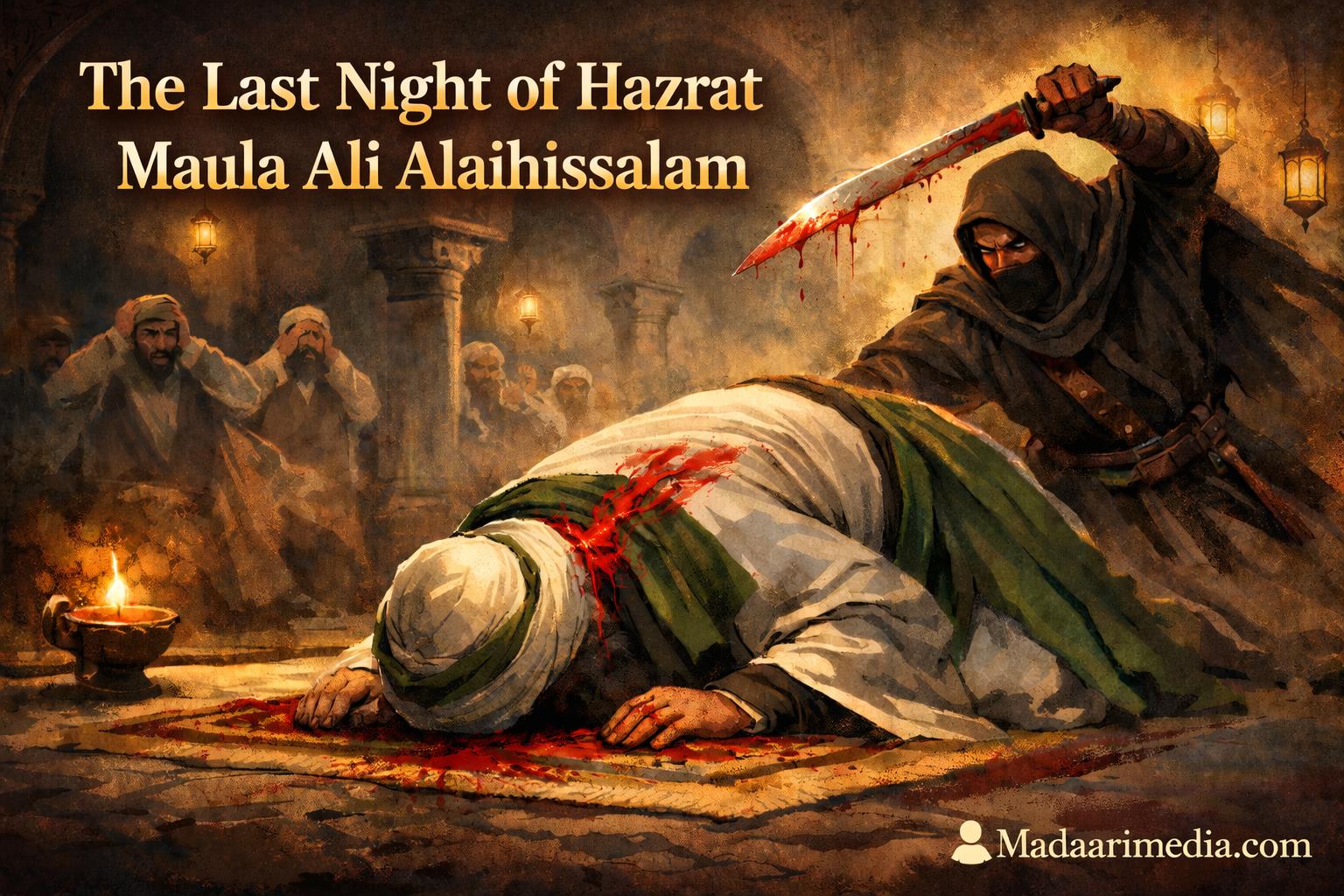
“The two most wretched people are: one from the people of Thamud who hamstrung the she-camel of Prophet Salih عليه السلام, and the other is the person who will strike your head with a sword, causing your beard to be drenched in blood.”
Hakim narrates on the authority of Abu Sa‘id al-Khudri رضي الله عنه that some people came to the Messenger of Allah ﷺ and complained about Hazrat Ali رضي الله تعالى عنه. The Prophet ﷺ immediately delivered a sermon and said:
“O people! Never complain about Ali. He is extremely firm and uncompromising in the path of Allah Almighty and in matters concerning His religion.”
[کتاب: تاریخ الخلفاء ص، ۲۵۵ – ۲۶۰]