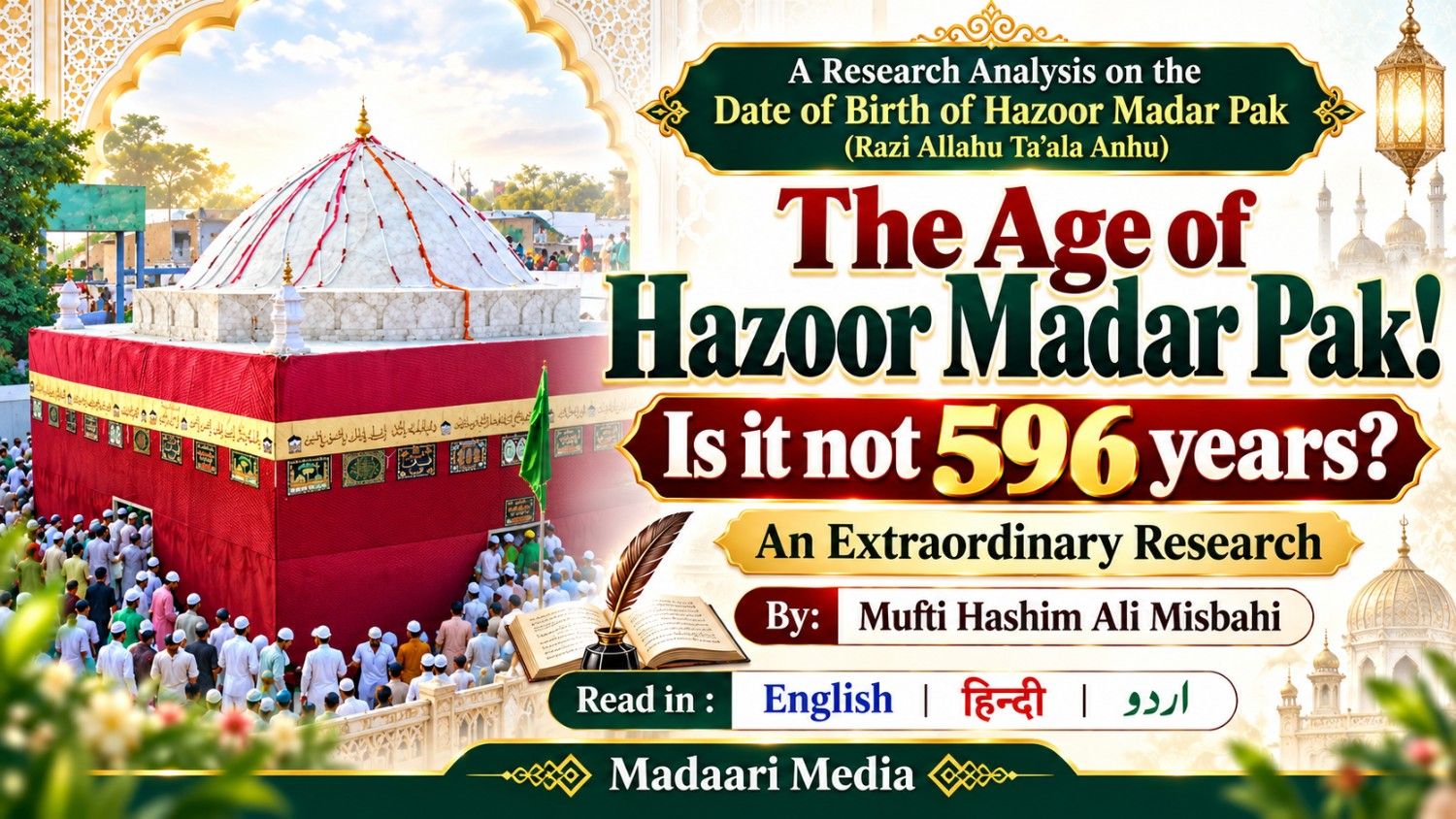
A Critical Examination of the Year of Birth
- Huzoor Madar-e-Pak Birth Date
- Zinda Shah Madar Birth Date
- Hazrat Madar Pak Date of Birth
- Qutb-ul-Madar Birth History
- Birth Date of Badiuddin Zinda Shah Madar
- Madar-e-Pak Birth Year Research
- Zinda Shah Madar Birth Year 242 AH
The preferred and correct year of birth of His Eminence, the Halabi Saint (may his secret be sanctified), is 242 AH. This means that he was born in the 3rd century AH. The phrase “Sahib-e-Alam” is well known as the chronogram of his birth. Some biographers, without presenting any evidence, mistakenly recorded his birth in the 5th and 8th centuries AH. This is entirely contrary to historical events and research-based accounts. His Eminence (may his secret be sanctified) was born and grew up in the 3rd century AH.
Some of the evidence supporting this is presented below.
1.
It is explicitly stated in early, authentic biographical works that Hazrat Qutb-ul-Madar (may his secret be sanctified) had been born in the 3rd century AH, although there are differences of opinion regarding the exact year. For instance:
Mulla Lal Badakhshi, born in 964 AH, writes in his book Thamarat-ul-Quds:
گویند تولد وے در سنه خمسين ومأتين وقيل ثلثمأة بوده و عمر دراز یافته ألخ……
Translation: It is reported that Hazrat Qutb-ul-Madar (may Allah be pleased with him) was born in 250 AH. According to another account, he was born in 300 AH and lived a long life.
[Thamarat-ul-Quds min Shajarat-ul-Uns, p. 26, manuscript at Raza Library, Rampur; year of compilation: 1006 AH.]
Sheikh Abdul Basit Kannauji (may Allah have mercy on him) writes:
وطنش حلب تاریخ تولد غره ماه شوال وقت فجر روز دوشنبه سنه سه صد ہجرة النبوی ، حیاتش پانصد سال۔
Translation: His maternal homeland was Aleppo. His Eminence was born on Monday, at dawn, on the first day of Shawwal in the 3rd century AH, and lived for 500 years.
[Madar-ul-Asrar fi Khawariq Shah Badi‘uddin Madar, p. 2, manuscript at Islamia College, Peshawar.]
Sheikh Najibuddin Nagori, in his book Makhzan-ul-I‘ras, writes:
بدیع الدین شاہ مدار شب جمعه در سال هشتصد و چهل و تولد در دو صد و بست و یا پنجاہ و یکہ مدت عمر ششصد هشت و چهار سال۔
Translation: Badi‘uddin Shah Madar passed away on Friday night in 840 AH. He was born in 220 or 250 AH and lived for 684 years.
[Makhzan-ul-I‘ras, Vol. 1, p. 164, manuscript at Raza Library, Rampur; date of transcription: 1252 AH.]
In Fusul-e-Mas‘udiyah, a quotation from Tuhfat-ul-Abrar states:
تولد وے در سنه خمسين و مأتين وقيل ثلثمأة بود، در موضعے که سه منزل از رود نیل ست زادگاه وی است۔
Translation: His Eminence was born in 300 AH—or, according to another account, in 250 AH—in a place situated three kos from the River Nile.
[Fusul-e-Mas‘udiyah, p. 180, published by Asah-ul-Matabi‘ Asi, Lucknow; year of publication: 1331 AH.]
All these pieces of evidence demonstrate that Hazrat Qutb-ul-Madar was born in the 3rd century AH. The reported years differ, with 250 AH and 220 AH among the stated possibilities. He lived a long life and passed away in 840 AH.
2.
Biographers have unanimously recorded that Hazrat Qutb-ul-Madar’s religious education and spiritual training took place under Hazrat Sadiduddin Huzayfah bin Qatadah Mar‘ashi Shami (may his secret be sanctified). Here, we shall suffice with just one piece of evidence. For further details, see Chapter Three of Volume One of Tazkirah Mashaikh-e-Madariya.
In Baqiyat-us-Salihat, a work from the Mughal Emperor Akbar’s era, the following account is quoted from Nafhat-ul-Azhar:
واز زیارت مزار مرتضوی فیضیاب شده عازم هندوستان شد اثنای راه در صحرای گزر شد، در آں جا دو نفر ابدال آمدند و وی را در کوه برده در بستان رسانید، بردرش پیر مردے بشکل نورانی دید، نامش معلوم شد که طیفور شامی است، این را دیده بگفت، بدیع الدین! السلام علیک ، خواجه بانتظار تست، بدیع الدین از شنیدن نام خود متعجب شد، فرمود: جای تعجب نیست ہر کہ ترا باینجا رسانیده است، آں نیز مرا از نامش آگاہی داده است، و عنقریب تو نیز بایں مرتبه خواہی رسید، و دست بدیع الدین گرفته اندر بستان آورد دید کہ در کوشک پر تکلیف بر تخت خواجه بایزید بسطامی جلوه افروز اند و قریب تخت مع دوات و قلم خواجه حذیفہ شامی غرق بانوار الہی سر افگنده نشسته اند، حضرت خواجه بایزید بسطامی با حذیفه شامی فرمود کہ تو نیز بدیع الدین را چیز بده، خواجہ حذیفہ شامی از دوات و قلم دعای بشمخ مع عزیمت تحریر کرده با بدیع الدین بخشید، ازاں بعد خواجه بایزید بسطامی از بدیع الدین فرمود کہ بر و خدا حافظ عازم هندوستان شو۔
Translation: After receiving spiritual blessings through visiting the shrine of Murtazavi, Hazrat Badi‘uddin Qutb-ul-Madar (may his secret be sanctified) set out on a journey towards India. On the way, he passed through a wilderness, where two Abdal appeared and took him to a garden in Koh-e-Burdah.
At its entrance, he saw a radiant-looking elderly saint. He learned that the saint’s name was Tayfur Shami. Upon seeing Badi‘uddin, the saint said, “Badi‘uddin! Peace be upon you. The Khwaja is waiting for you.”
Badi‘uddin was astonished to hear his own name. The saint explained, “There is no cause for astonishment. The one who brought you here has also informed me of your name. Soon, you too will attain this spiritual station.”
He then took Badi‘uddin by the hand and led him into the garden. There, he saw Hazrat Khwaja Bayazid Bistami seated resplendently upon a throne in a magnificent pavilion. Near the throne, Hazrat Khwaja Huzayfah Shami sat with an inkpot and pen, his head bowed and immersed in Divine Light.
Hazrat Khwaja Bayazid Bistami said to Huzayfah Shami, “You too should bestow something upon Badi‘uddin.” Hazrat Khwaja Huzayfah Shami wrote a prayer known as Du‘a-e-Bashmakh with his inkpot and pen and presented it to Badi‘uddin. Thereafter, Khwaja Bayazid Bistami said to Hazrat Badi‘uddin Qutb-ul-Madar, “May Allah protect you. Proceed on your journey to India.”
[Baqiyat-us-Salihat ma‘ Tabqat-ul-Awliya, p. 20, owned by Anwar Samadani; date of transcription: 1330 AH.]
This passage from Nafhat-ul-Azhar makes it clear that Hazrat Huzayfah Shami (may Allah be pleased with him) was the esteemed teacher of Hazrat Qutb-ul-Madar. Hazrat Huzayfah Shami passed away in 252 AH, as recorded by Sheikh Allah Dih bin Abdur Rahim Chishti, who died in 1036 AH, in Siyar-ul-Aqtab:
نقل است که آں حضرت بست و چهارم شوال سنه اثنی و خمسين و مأتین به رحمت حق پیوست چنانکه این دعا گوی درویشان تاریخش “قطب زمان بودہ” است۔
Translation: It is reported that His Eminence, Hazrat Huzayfah Shami, passed into the mercy of Allah on 24 Shawwal al-Mukarram, 252 AH. This humble devotee of the dervishes found his date of passing through the chronogram “Qutb-e-Zaman Budah.”
[Siyar-ul-Aqtab, p. 50, edited with an introduction by Dr Akram Muhammad Sarwar Maulayi, published by the Centre for Persian Research, Tehran, 1386 AH.]
In light of all these details, it is reasonable to conclude that Hazrat Qutb-ul-Madar (may Allah be pleased with him) was born in the land of Aleppo before 252 AH, with 242 AH being the preferred date. This also makes it clear that the dates 300 AH and 250 AH are incorrect, because it is inconceivable that Hazrat Qutb-ul-Madar could have received religious instruction from Hazrat Huzayfah Mar‘ashi Shami when he was only two years old.
3.
The majority of biographers have accepted that Hazrat Qutb-ul-Madar (may his secret be sanctified) was a disciple of Sultan-ul-Arifin Hazrat Bayazid Bistami, also known as Tayfur Shami (may Allah be pleased with him), and received the Sufi robe of spiritual succession from him. The spiritual lineages attributed to Hazrat Qutb-ul-Madar, which contain relatively few intermediaries, also support this view.
A few pieces of evidence are presented below. For further details, see Chapter Three of Volume One of Tazkirah Mashaikh-e-Madariya.
Abul Fazl Allami writes in his book Ain-e-Akbari:
شاہ مدار لقب بدیع الدین کہ و مہ ہندی بوم بدو گرد والا پایگی اور برگزارد، گویند مرید شیخ محمد طیفوری بسطامی است۔
Translation: Shah Madar is the title of Badi‘uddin. Every person, young or old, in India holds him in esteem and speaks of his spiritual rank. It is said that he was a disciple and spiritual successor of Sheikh Muhammad Tayfuri Bistami.
[Ain-e-Akbari, p. 219, published by the Asiatic Society of Bengal.]
Dara Shikoh Qadiri writes in Safinat-ul-Awliya:
حضرت سید بدیع الدین قدس سرہ لقب ایشاں شاہ مدار است و مرید شیخ محمد طیفور شامی۔
Translation: The title of Hazrat Sayyid Badi‘uddin (may his secret be sanctified) is Shah Madar, and he was a disciple and spiritual successor of Sheikh Muhammad Tayfur Shami.
[Safinat-ul-Awliya, p. 321, Matba‘ Madrasa, Agra, 1853 CE.]
Hazrat Sheikh Azizullah Kanturi writes in Tuhfat-ul-Abrar:
قطب المدار با وجود نسبت اویسیت بروح پر فتوح سرور کائنات خلاصۂ موجودات محمد مصطفی صلی اللہ علیہ وآلہ وسلم در عالم ناسوت خلافت و ارادت از شیخ محمد طیفوری و از شیخ عبداللہ شامی که از علما شام بود۔
Translation: In addition to possessing an Uwaysi spiritual connection with the blessed and luminous spirit of the Master of the Universe, the essence of all creation, Muhammad Mustafa ﷺ, Hazrat Qutb-ul-Madar was, in the outward world, a disciple and spiritual successor of Hazrat Sheikh Muhammad Tayfuri and Hazrat Sheikh Abdullah Shami, who was among the scholars of Syria.
[Tuhfat-ul-Abrar fi Manaqib Qutb-ul-Madar, p. 31, manuscript at Maulana Azad Library, Aligarh; date of transcription: 1025 AH.]
Hazrat Shah Waliullah Muhaddith Dehlawi, in a letter addressed to Baba Usman Kashmiri, records the spiritual lineage of Hazrat Qutb-ul-Madar as follows:
Hazrat Shah Badi‘uddin Madar received the Sufi robe from Sheikh Tayfur Shami; he received it from Yaminuddin Shami; he received it from Sheikh Abdullah, the bearer of the Prophet’s ﷺ banner; he received it from Hazrat Abu Bakr Siddiq (may Allah be pleased with him); and Hazrat Abu Bakr received it from the Master of Both Worlds, Hazrat Muhammad ﷺ.
[Nadir Maktubat Hazrat Shah Waliullah Muhaddith Dehlawi, Vol. 2, p. 189, Letter No. 89, researched and translated by Mufti Nasim Ahmad Faridi Amrohvi, Bharat Offset, Delhi, 1998 CE.]
Hazrat Makhdoom Ashraf Jahangir Simnani speaks about the Tayfuriyya family:
طیفوریان چہار تن بودند، شیخ مسعود و شیخ محمود و شیخ ابراہیم و شیخ احمد و شیخ مسعود طیفوری خرقہ شکر پارہ کہ آنرا تماچہ ہم گویند در بر کرد و شیخ محمود طیفوری با ہزار ریشه سیاه کہ آنرا خرقہ ہزار میخی گویند در بر کرد و شیخ ابراہیم خرقہ خشت پاره مربع در بر کرد و شیخ احمد طیفوری خرقہ صوف در بر کرد۔
Translation: Sultan-ul-Arifin Tayfur (Bayazid Bistami) had four successors: Sheikh Masud, Sheikh Mahmud, Sheikh Ibrahim, and Sheikh Ahmad (Badi‘uddin Madar). Sheikh Masud Tayfuri wore the Khirqa Shakarparah, also called Tamacha. Sheikh Mahmud Tayfuri wore a black robe with a thousand threads, known as the Khirqa Hazār Mīkhī. Sheikh Ibrahim Tayfuri wore a square Khirqa Khishtparah, while Sheikh Ahmad Tayfuri was bestowed with the woollen Khirqa Suf by the Sheikh.
[Lataif-e-Ashrafi, Vol. 1, p. 349, Fourteenth Latifa, concerning the families of the Mashayikh, published by Nusrat-ul-Matabi‘, Delhi.]
All these references indicate that Hazrat Qutb-ul-Madar was a disciple and spiritual successor of Hazrat Bayazid Bistami, Tayfur Shami. Hazrat Bayazid Bistami passed away in 261 AH, as recorded by Sheikh Abdul Ghani Nabulsi (may Allah have mercy on him) in his travelogue Al-Haqiqah wa al-Majaz:
“و البسطامي بفتح الباء الموحدة وقيل بكسرها نسبة إلى بلد بطريق نيسابور ذكره السيوطي في لب اللباب و اسمه طيفور بن عيسى بن آدم بن عيسى بن علي أحد مشايخ الصوفية وكان جده مجوسيا فأسلم و كان لأبي يزيد إخوان صالحان عابدان وهو أجلهم، قال ابن خلکان و له مقامات و مجاهدات مشهورة و كرامات ظاهرة، توفي سنة إحدى و ستین و مأتين۔”
Translation: “Bistami,” with the letter ba pronounced with a fatḥah, and according to another opinion with a kasrah, is an attribution to a town on the route to Nishapur, as mentioned by Imam Suyuti in Lub al-Lubab. Abu Yazid Bistami’s name was Tayfur bin Isa bin Adam bin Isa bin Ali. He was one of the Sufi masters. His grandfather was a Magian who later embraced Islam. Abu Yazid had two righteous and devout brothers, and he was the most eminent among them. Ibn Khallikan states that Hazrat Tayfur Bistami was renowned for his spiritual stations, spiritual struggles, and manifest miracles. He passed away in 261 AH.
[Al-Haqiqah wa al-Majaz fi al-Rihlah ila Bilad al-Sham wa Misr wa al-Hijaz, p. 43, Egyptian General Book Authority, 1986 CE.]
In light of all these details, the conclusion is that the correct year of birth of Hazrat Qutb-ul-Madar (may his secret be sanctified) is 242 AH. He received the honour of pledging spiritual allegiance to Hazrat Bayazid Bistami, and Sultan-ul-Arifin passed away in 261 AH. Therefore, the preferred and historically substantiated opinion is that Hazrat Qutb-ul-Madar was born in the 3rd century AH.
4.
Among the great and resolute personalities of his era with whom Hazrat Qutb-ul-Madar (may Allah be pleased with him) is established to have met were Hazrat Sheikh Abu al-Abbas Ahmad bin Masruq, Hazrat Mahmud of Ghazni, Hazrat Sahu Salar Ghazi, Hazrat Salar Masud Ghazi, Hazrat Sikandar Diwana, Hazrat Ghaus-e-Azam Jilani, Hazrat Khwaja Gharib Nawaz Ajmeri, and Hazrat Imaduddin Shami Bilgrami, along with other eminent personalities.
Among these distinguished figures, the earliest belonged to the 3rd century AH, while the others belonged to the 4th, 5th, and 6th centuries AH. The fact that Hazrat Qutb-ul-Madar is established to have met these personalities clearly indicates that he was born in the 3rd century AH and remained alive for five centuries.
For a detailed account of the meetings between Hazrat Qutb-ul-Madar and the aforementioned personalities, see Chapter Five of Volume One of the book Tazkirah Mashaikh-e-Madariya.
5.
According to one narration, Hazrat Qutb-ul-Madar (may Allah be pleased with him) had two brothers, while another account states that he had three. One of his brothers was named Hazrat Muhammad, who became renowned by the titles “Akhu Muhsin” and “Sharif Abid.”
Ibn Asakir (born in 499 AH and died in 571 AH) writes about him in Tarikh Madinat Dimashq:
محمد بن علي بن الحسين بن أحمد بن إسماعيل بن محمد بن إسماعيل بن جعفر بن محمد بن علي بن الحسين بن علي بن أبي طالب أبو الحسين العلوي المعروف بأخي محسن و يعرف بالشريف العابد كان زاهدا منقطعا في بيته و له تصانیف و مات الشريف محمد أخو محسن العلوي و هو الصغير وكان لازما للبيت متعبدا صالحا في يوم الثلاثاء لثلاث و عشرين ليلة خلت من جمادى الأولى سنة ثمان و تسعين و ثلاثماة و صلي عليه في المصلى وكان له مشهد عظيم۔
Translation: Muhammad bin Ali bin Husain bin Ahmad bin Ismail bin Muhammad bin Ismail bin Ja‘far bin Muhammad bin Ali bin Husain bin Ali bin Abi Talib, Abu al-Husain al-Alawi, known as Akhu Muhsin and also as Sharif Abid, was an ascetic who remained secluded in his home. He authored several works. Sharif Muhammad Akhu Muhsin al-Alawi, the younger of the brothers, was a devout, secluded, and righteous man. He passed away by the will of Allah on Tuesday, on the 23rd night of Jumada al-Awwal, 398 AH. His funeral prayer was offered at the prayer ground, and he had a magnificent shrine.
[Tarikh Madinat Dimashq, Vol. 54, p. 307, Dar al-Fikr, Beirut, 1418 AH.]
This passage indicates that Hazrat Qutb-ul-Madar’s younger brother, Hazrat Akhu Muhsin, passed away in the 4th century AH. This is clear evidence that Hazrat Qutb-ul-Madar (may his secret be sanctified) belonged to the 3rd century AH, and that the year of his birth, 242 AH, is correct and historically substantiated.
A Critical Examination of Certain Less-Preferred Opinions
The preceding discussion makes it clear that the years of birth recorded by other biographers, such as 590 AH and 716 AH, are not free from weaknesses and errors and fall among the less-preferred opinions. Further clarification is provided below.
Sheikh Abdur Rahman Chishti [1005–1094 AH], while mentioning his year of birth in Mir’at-e-Madari, writes:
تولد آں حضرت در سنہ خمس و عشر و سبع مأۃ بولایت شام کہ بہشت روے زمین است واقع شده بود و یک صد و بست و پنج سال عمر داشت۔
Translation: His birth took place in 715 AH in the land of Syria, which is the paradise of the earth. He lived for 125 years.
[Mir’at-e-Madari, p. 141, manuscript preserved at Khuda Bakhsh Library, Patna; date of transcription: 1304 AH.]
Similarly, Fazil Tirmizi Akbarabadi, author of Mukhbir-ul-Wasilin [died in 1103 AH], writes the following verses:
عمر آں شاہ مطلع الانوار
یک صد و بست و چار سال شمار
شده سال طلوع آن بیقین
شمس دنیا و دين بديع الدين
Translation: The age of that Shah, Matla‘ al-Anwar, is counted as 124 years. The year of the advent of the sun of the world and religion, Badi‘uddin, is certainly established as 816 AH.
After presenting these two references, it must be stated that assigning this year of birth contradicts the writings of these very authors. Sheikh Abdur Rahman Chishti, the author of Mir’at-e-Madari, writes in his other work, Gulistan-e-Mas‘udiyah, quoting Risalah Qutbiyah:
In short, after meeting Khwaja Muinuddin Chishti, the Five Pirs reached Bahraich Sharif in the company of Hazrat Bakhtiyar Kaki. During this time, they had the honour of meeting Qutb-ul-Madar, Sayyid Badi‘uddin Zinda Shah Madar. Upon seeing the Five Pirs, Zinda Shah Madar remarked, “After a long time, the fragrance of the Siddiqin has reached my senses.”
The Five Pirs—Hazrat Sayyid Aslam Ghazi, Hazrat Sayyid Akram Ghazi, Hazrat Sayyid Sufi Ghazi, Hazrat Sayyid Malik Ghaus Ghazi, and Hazrat Sayyid Muhammad Ghazi—remained in his blessed service for several days, progressing through the stages of the spiritual path. After receiving the robe of spiritual succession, they paid their respects and, according to his instructions, departed to visit the sacred places.
[Gulistan-e-Mas‘udiyah (translated edition), pp. 16–17, published by Muhammad Salim Ghazi and Muhammad Hafiz Ghazi, Al-Jami‘ah al-Ghaziyah, Koilsa Bazaar, Azamgarh District.]
Similarly, the author of Mukhbir-ul-Wasilin, identifying Hazrat Tayfur Shami as the outward spiritual guide and mentor of Hazrat Qutb-ul-Madar, writes:
آنکہ قطب مدار عالم بود
پادشاہ ممالک دین بود
شاہباز رواق علیین
نامدار جہاں بدیع الدین
یمنی ست شامی و حلبی
پیشوائی رہ خدا طلبی
آن شہنشہ کہ مطلع نور ست
از مریدان شاه طیفور است
لیک ویسی ست آن ستودہ سپر
یافت عرفان ز روح پیغمبر
Translation: He is the Qutb-ul-Madar of the world, the sovereign of the realms of religion and the world, and the falcon of the highest heavenly abode, meaning that he is of noble lineage. His honoured name is Badi‘uddin. He is Yemeni, Shami, and Halabi, and a guide on the path of seeking Allah. This emperor, who is a source of light, belongs to the disciples of Shah Tayfur. Yet this praiseworthy personality is also an Uwaysi, for he received spiritual knowledge and blessings from the spirit of the Prophet ﷺ.
[Mukhbir-ul-Wasilin, p. 63, Matba‘ Mustafai, Lahore.]
From this detailed account, it becomes clear that the Five Pirs met Hazrat Qutb-ul-Madar before 620 AH. A few lines after this incident, the following is recorded:
In 620 AH, when Hazrat Sayyid Aslam Ghazi learned that the disbelievers in Bahraich Sharif were preparing for battle, he immediately crossed the river to confront them, and fighting began. A very fierce battle took place.
[Gulistan-e-Mas‘udiyah, p. 17, published by Al-Jami‘ah al-Ghaziyah, Azamgarh.]
Furthermore, the Shah Tayfur mentioned here refers to Hazrat Bayazid Bistami, known as Tayfur Shami, whose year of death was 261 AH, as explained in detail earlier.
Therefore, it is not merely difficult but impossible for a saint born in 716 AH to have met, during his lifetime and in an outward physical encounter, Hazrat Bayazid Bistami, Hazrat Huzayfah Shami, and Qutbuddin Bakhtiyar Kaki (may Allah be pleased with them). This establishes that the years of birth assigned by Mir’at-e-Madari and Mukhbir-ul-Wasilin are incorrect and lack proper historical verification.
Some writers, interpreting the expression “Māh-e-Ālamtāb” as a reference to his birth year, recorded his year of birth as 590 AH. Others interpreted “Shah-e-Kawnain” in the same way and wrote 442 AH. Another writer, understanding the expression “Māh-e-Kawnain” in this manner, was inclined to accept 177 AH as his year of birth. However, the stronger opinion is that these are merely titles of Hazrat Qutb-ul-Madar. Deriving his year of birth from these titles is no more valid than calculating his birth year from any of his other titles.
This article has been reproduced from “A Critical Examination of the Year of Birth of Hazrat Madar Pak,” on page 171 of Chapter One, Volume One of Tazkirah Mashaikh-e-Madariya, authored by Mufti Muhammad Hashim Ali Misbahi.