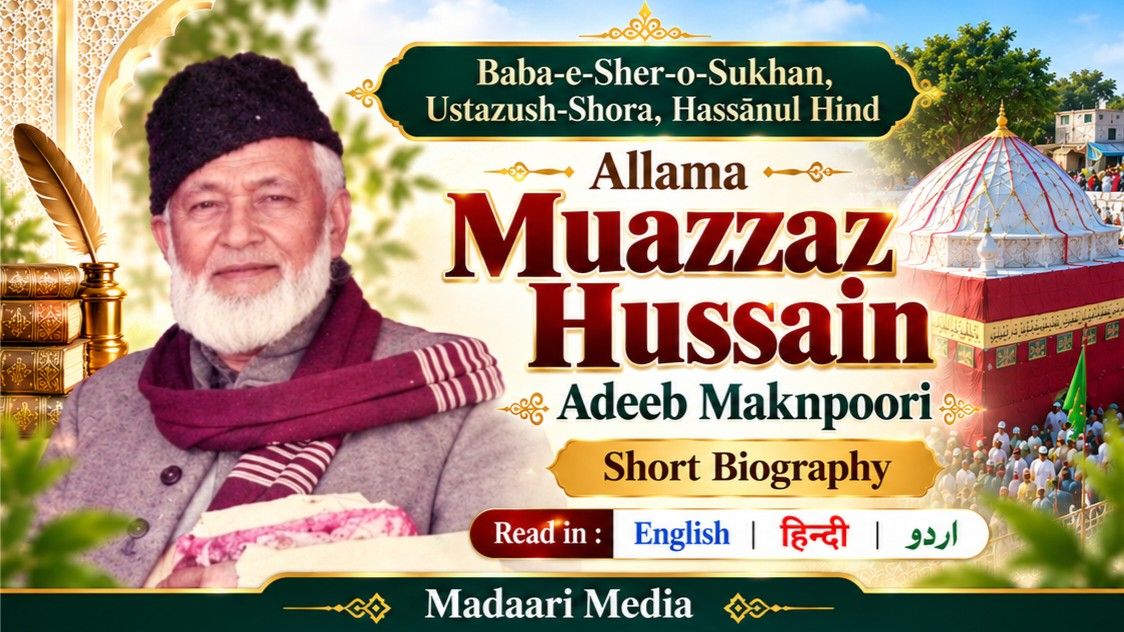
The Father of Poetry and Eloquence, the Teacher of Poets, Hassān-ul-Hind, Allama Mu‘azzaz Husain Adeeb Maknapuri (Quddisa Sirruhu)
Alhamdu li-waliyyihi was-salatu ala nabiyyihi wa aalihi
On Monday, 14 July 1924, the manifestation of the grace of Qutb-ul-Madar took place in the household of Shaikh-e-Tariqat and Ataliq-e-Dauran, Munshi Syed Karamat Husain Ja‘fari Madari (Alaihir Rahmah). In the form of Syed Mu‘azzaz Husain, a literary figure was born who, in the years to come, would shine over the world of knowledge and literature like the midday sun, owing to his intelligence and profound scholarship. When his respected father gave him his name, the door of acceptance of prayers must have been open, and Allah must have made the newborn worthy of his name.
From childhood, Allama Adeeb Maknapuri was highly intelligent, fond of knowledge, and filled with an intense desire to acquire learning. He received his elementary education from his respected father, after which his journey of learning continued gradually. He acquired knowledge and spiritual blessings from many eminent and respected elders and studied under the great teachers of his time. Since you were a Hasani-Husayni Syed, and the blood of Sayyidah Fatimah flowed through your veins, you were also blessed with Fatimid intelligence.
From childhood, poetic thought came to you as a natural inheritance. You composed poetry in every genre, but Na‘t-goi—composing poetry in praise of the Holy Prophet ﷺ—became your distinguishing characteristic. In your Na‘t poetry, you presented such perspectives as were unparalleled. And why should it not have been so? When a member of the Prophet’s family composes poetry in praise of the Messenger of Allah, the matter naturally becomes extraordinary. Furthermore, you possessed an Uwaisi spiritual connection with the court of Qutb-ul-Madar.
You would often relate an important incident from your life:
“My respected paternal aunt’s husband, Sadr-ul-Mashaikh, Saqi-e-Mai-Khana-e-Tasawwuf, Syed-ul-Asfiya, Shaikh-e-Tariqat, Hazrat Syed Sardar Ali Ja‘fari Madari (Alaihir Rahmatu war-Ridwan), the Sadr Sajjada Nashin and Takht Nashin of Khanqah-e-Aaliya Madariya, received glad tidings from the blessed court of Madar Pak that a particular spiritual practice should be bestowed upon Syed Mu‘azzaz Husain Adeeb Maknapuri.
“When these glad tidings were received repeatedly, he summoned me and said, ‘Mu‘azzaz Husain, perform ablution.’ I performed ablution. He then put on his special robe, which he wore when sitting upon the seat of spiritual succession, spread out his spacious cloak, and instructed me to offer two rak‘ahs of voluntary prayer. I offered two rak‘ahs. After that, he initiated me as a disciple upon his blessed hand and bestowed upon me the spiritual practice concerning which he had received the glad tidings. He advised me to remain committed to it throughout my life.
“I remained steadfast in that practice and never abandoned it, whether travelling or at home. Through its blessings, hidden and closely guarded secrets began to be unveiled to me. Allah, Allah!”
The gaze of a true believer can transform destinies.
You were bestowed with blessings from the court of Qutb-ul-Madar, and receiving this gift through his special successor was the pinnacle of your good fortune.
Along with being an outstanding poet, you possessed complete mastery over many other arts and disciplines. Your Nastaliq calligraphy was exquisite, and your handwriting was so beautiful that merely looking at it delighted the eyes. Allah Almighty had blessed you in every respect—with beauty of appearance, character and conduct, patience, forbearance, wit, and good manners. Your noble character was such that anyone who met you even once would become attached to you.
Your contemporary poets and men of letters held you in the highest esteem and greatly appreciated your literary abilities. Before one particular poetic gathering, the poets were discussing a certain word. When you arrived, everyone stood up out of respect. Firaq Gorakhpuri immediately remarked, “Look, Adeeb Bhai has arrived. If he endorses this word, I will no longer care about anyone else’s opinion.”
This incident reveals the high standard of knowledge and literary judgement attained by Allama Adeeb Maknapuri.
You composed poetry in every genre, including ghazal, elegies, qasida, rubai, wedding songs, farewell compositions, and nazm. However, you adopted Na‘t-goi as your distinguishing practice, regarding it as a great act of worship. You became unparalleled in both composing and reciting Na‘t. Allah Almighty had also bestowed upon you an exceptionally melodious voice. When you recited Na‘t, immersed in the ecstasy of love for the Messenger of Allah, it seemed as though the atmosphere itself had become still and was listening attentively. An extraordinary spiritual state would descend upon every heart.
Qari Raziullah Sahib (Rahmatullahi Alaih) once remarked:
“Allah Almighty created Adeeb Sahib specifically to compose Na‘t.”
On one occasion, Allama Adeeb Maknapuri was reciting Na‘t at a poetic gathering in Kanpur. Some of the most distinguished poets of that era were present on the platform. You recited the following couplet:
Woh aalam haaye woh aalam jahannam jaane wale ka
Shafi-e-hashr ka mur mur ke rasta dekhta hoga
Khumar Barabankvi became overwhelmed with emotion and tears filled his eyes. He repeatedly requested that the couplet be recited again. Finally, when you had recited it and sat down, he made another request:
“Adeeb Sahib, for God’s sake, please recite this couplet one more time. I wish I had composed it myself!”
There are many such incidents, and narrating them all in detail would make this article excessively long. Therefore, I am writing only briefly.
Whenever you composed verses of Na‘t, an extraordinary state would overcome you. Tears would fill your eyes, sighs and cries would escape your lips, and your emotional expressions would make it seem as though you were immersed in the ocean of love for the Messenger of Allah.
As examples, I present a few of your couplets:
Apne anjaam se dil pareshan tha, fard-e-isyaan thi, roz-e-jaza haath mein
Woh to kahiye bari khairiyat ho gayi, aa gaya daaman-e-Mustafa haath mein
Seerat aisi ke aghyaar kalma parhein, soorat aisi ke Yusuf bhi dekha karein
Paaon aise ke Jibreel aankhein malein, Ibn-e-Maryam se behtar shifa haath mein
While expressing the pain of separation, you say:
Kya jaane hayat-e-do-roza phir itni bhi mohlat de ke na de
Hum aaj yahin se tujh ko salaam, ae Gunbad-e-Khazra, karte hain
Ae aazim-e-Taiba, leta ja ashkon ki amanat Aaqa tak
Kya jaane ise hum jeete ji le ja sakein ya le ja na sakein
In praise of the blessed features of the Holy Prophet ﷺ, you say:
Aap ka sar aur aap ka seena, asraar-e-Haq ka ganjeena
Aankhein hain do noor ke saghar, Sallallahu Alaihi Wasallam
Paa-e-mubarak, dast-o-baazu, mash’al-e-roshan har har pehlu
Aap ka dil rahmat ka samandar, Sallallahu Alaihi Wasallam
Noor ke khatt hain abru-o-beeni, peshani par maah-jabeeni
Aariz phool to dandan gauhar, Sallallahu Alaihi Wasallam
While teaching the proper manner of composing Na‘t, you say:
Ya Rab mujhe woh Na‘t ki taufeeq ata ho
Jo rutba-e-Aaqa se na kam ho na siwa ho
While describing divine mercy, you say:
Khak par khoon-e-athar se gulkaariyan aur namood-e-baharaan ki lab par dua
Arz-e-Taif se poochho ke kis shaan se uth rahe the Habib-e-Khuda ke qadam
While referring to the ultimate destination of the journey of love, you say:
Ho chuki tai hadd-e-Sidrat-ul-Muntaha, ab na jada na manzil ka koi pata
Barh rahe hain magar ishq ke rahnuma, leke mahboobiyat ka asa haath mein
At times, you expressed your longing and heartfelt desire in these words:
Kash Sarkar yeh farma dein ke ja deewane
Hum junoon ko tere sehra-e-Arab dete hain
Through your Na‘t poetry, you expressed your love for the Messenger of Allah in every possible way. You presented your sorrows and grievances before your beloved master and opened new avenues for those who compose Na‘t.
You composed such a vast quantity of poetry that, if all of it were collected, it would amount to thousands of verses. Unfortunately, a great deal of your work was lost. Whatever remained preserved is being published in this book, Nayyir-e-Azam, so that people may read it and benefit from the spiritual states associated with love for the Messenger of Allah.
Apart from poetry, you were equally unparalleled in prose. When the opponents of the noble Madariya spiritual order began making allegations against the Madariya Silsilah, you demonstrated such excellence in prose that even the most eminent scholars were astonished. Through both your speech and your pen, you consistently served the Urdu language and literature, dedicating yourself to the service of humanity.
You were the founder and principal figure behind an organisation known as Da’irat-ul-Adab. You continued to guide and refine the literary abilities of your students. Keeping the literary atmosphere active under all circumstances was one of your habits. Your method of correction was extraordinary: you would correct several students simultaneously, and never make a mistake. This was a special grace from Madar Pak that remained with you throughout your life.
You never hurt anyone’s feelings. Through every aspect of your conduct, you demonstrated that you belonged to the noble Hasani-Husayni lineage. You always avoided pride and those who were arrogant.
You were the court poet of Qutb-ul-Madar, and you enjoyed the special favour and grace of Madar Pak—and that grace continues even today. You participated in major gatherings throughout India, and no significant programme felt complete without your presence.
Fulfilling your responsibilities under all circumstances was another defining characteristic of yours. Even during illness, you never neglected your scholarly pursuits. After living an exemplary life, you departed from this transient world on Friday, 17 October 1996, and joined the Beloved, the True One.
Inna lillahi wa inna ilaihi raji’un.
Qit‘a on the Date of Demise
Teri turbat pe saaya-fagan
Rahmat-e-kul ki shafqat, Adeeb
Tujh pe qurban bahar-e-iram
Madah-khwan-e-risalat, Adeeb
1417 AH
Faqat was-salaam:-
Khaak-paye Adeeb Misbah-e-Wali, Hazrat Allama Mufti Khwaja Syed Misbah-ul-Murad Sahib Qibla Ja‘fari Arghuni Madari (Madazilluhu al-Aali wal-Noorani), Shaikh-ul-Hadith: Jamia Arabia Madar-ul-Uloom, Madinat-ul-Auliya, Makhanpur Sharif, Sajjada Nashin: Astana-e-Aaliya Madariya, Makhanpur Sharif. (8 January 2020)