On the Occasion of the Seventy-First (71st) Celebration of Independence Day
18 August, 2017
If any hand rises toward the honor of the nation,
Cut off that hand, do not show even the slightest regret.
Let it never touch the mantle of Hindustan,
In patriotism, deal with the enemy in this manner.
Today, the 71st celebration of Independence Day is being observed in our country.
The moment the word freedom appears on the screen of the mind, images begin to take shape at the margins of thought: the bodies of those oppressed Sayyid descendants of Dar-ul-Noor Makanpur Sharif, shackled in chains of cruelty; writhing and wailing faces; burning homes; huts turned into heaps of ashes; slap marks on the cheeks of crying and sobbing orphaned princes; blood-soaked welts on tender bodies flayed by whips.
The innocent children of oppressed Karbala who were made to thirst for every single drop of water.
Some were received on the cross and gallows, some were riddled with bullets, some were sentenced to Kala Pani, and some were burned alive.
Which cruelty was it that was not inflicted upon the princes of Qutb-e-Madar?
A cry of mourning had arisen in Makanpur Sharif.
When their thirst was not quenched by human blood, when burning homes and destroying settlements did not satisfy their impure hearts, those beast-like people advanced toward the Khanqah of Qutb-e-Madar and set its library on fire.
They desecrated sacred places. The Madrasa Madar-ul-Uloom established by Hazrat Khwaja Sayyid Abu Muhammad Arghun, the First Successor (Quddisa Sirrahu), was turned into ruins.
The Koh-e-Noor diamond gifted by King Ibrahim Sharqi of Jaunpur was removed from the sacred shrine, and many other rare and precious items were looted.
This fire of hatred, bigotry, and riots was not confined only to the Khanqah of Qutb-e-Madar and the princes of Madar in Makanpur Sharif, nor did it cool down there.
Rather, as this fire spread across the entire country, wherever Madari khanqahs were found, Madari chillahs were found, Madari seats were found, Madari gaddis were found, Madari symbols were found, Madari mashayikh, Madari scholars and the Sadat of Makanpur were found, malangs and faqirs were found — all were burned and reduced to ashes.
Madaris were hunted down among the masses and killed.
If one asks that there were other orders, other khanqahs, other madrasas and schools, other scholars and saints —
Then why was only the Madari order targeted and erased from the page of existence, and why did the British want to wipe out every trace of the Madari order?
To this question, I will say only this:
My dear friend!!!
When tyrants occupied this land, to practice their oppression they chose, without distinction of religion or community, human beings — “Indian human beings.”
And when humanity began to be torn and gnawed by the sharp new teeth of savagery; when farmers’ and artisans’ goods were forcibly purchased at fixed prices; when farmers and craftsmen were whipped and humiliated for selling their goods to others at better prices —
Then, from the mouths of cannons, from the marks of bullets, from the abodes of death, those brave warriors who stepped forward carrying their lives on their palms and shrouds on their shoulders to save and bring relief to the people of the land were the followers of the Madari order.
If the foundation of the freedom movement was laid first by anyone,
Then it was the first warrior of freedom,
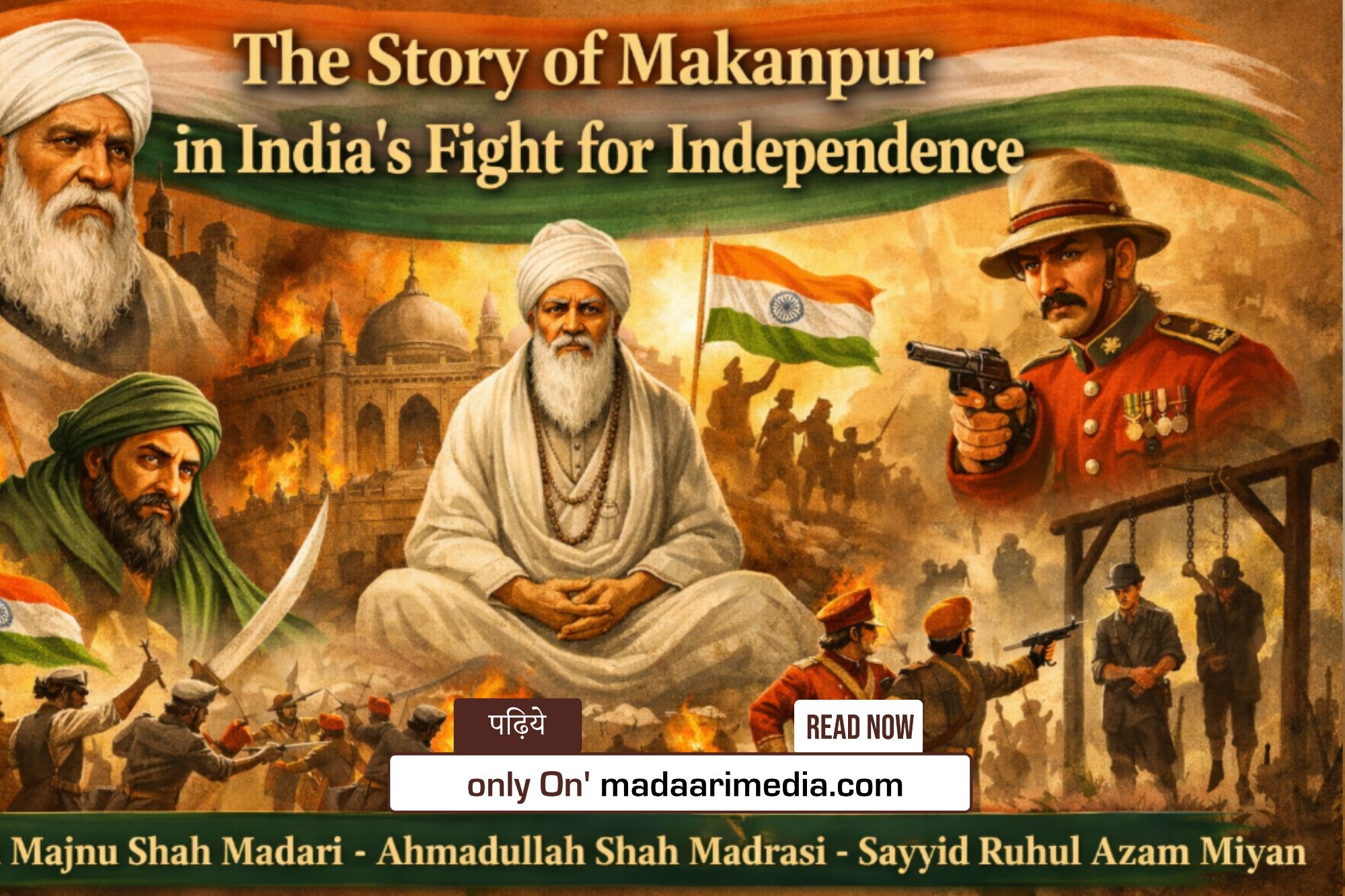
Hazrat Baba Majnun Shah Madari Malang, who was the earliest hero in the battle against the British.
In 1786, when he arrived in Makanpur Sharif wounded all over,
There stood indigo factories of three British brothers.
Their presence on this land was intolerable to him.
As he had the patronage of the Sadat of Makanpur Sharif, he took Hazrat Sayyid Ruh-ul-Azam Miyan Jafri Madari (may Allah’s mercy and pleasure be upon him) along and killed one of those three British brothers, “Peter Maxwell.”
When this news reached the British government, it launched an attack on Makanpur Sharif and destroyed the settlement.
The First Warrior: Hazrat Baba Majnun Shah Malang Madari
Hazrat Baba Majnun Shah Madari Malang was born in 1733 CE on this earthly realm.
In his youth, he was honored with the rank of khilafat and assumed leadership of the Diwanagan-e-Sultani order.
His ancestral forefather Hazrat Sultan Hasan Diwan Madari was granted certain privileges for missionary and propagational travels by Shah Shuja.
A written decree dated 1659 CE still exists in the royal office, in which Shah Shuja granted authority to Hazrat Sultan Hasan Diwan Madari:
Clause One:
Whenever you wish to travel through cities, villages, districts, or anywhere according to your will for the guidance of people or for journeys, you are authorized to carry all the procession’s equipment such as banners, flags, pennants, poles, staffs, drums, mahi, and insignia.
Clause Four:
Whenever you visit any part of the country, village landlords and cultivators shall arrange to provide you with food supplies.
Following in the footsteps of his forefather Hazrat Shah Sultan Hasan Diwan Madari, Hazrat Baba Majnun Shah Madari Malang traveled with royal splendor, carrying mahi, insignia, drums, and banners, for preaching, guidance, and spiritual reform in the regions of Odisha, Bihar, and Bengal.
People — Hindus and Muslims alike, without distinction of religion or community — revered and respected him.
This is why, without fear or terror, he laid the foundation of the freedom movement in 1763 against British oppression.
As the movement gradually grew, he inflicted a decisive defeat on Mackenzie in 1766.
In 1769, he decisively defeated Commander Keith’s army and beheaded him.
In 1770, he formally entered Bihar from Bengal with a group comprising Malangs, Madari faqirs, and other compatriots.
For many months, he raised the banner of jihad across various districts of North Bengal and the district of Dhaka.
In 1771, Lieutenant Taylor’s army was also defeated and fled.
In 1772, Hazrat Baba Majnun Shah Madari Malang delivered a letter to Rani Bhavani of Natore, containing a sworn statement representing the welfare of the nation, and sought her help by presenting the principle that “every oppression is acceptable” for this great cause.
Several British companies prepared many military camps to confront these armed faqirs and ascetics, but Baba remained an illusion for them. The British could not succeed in their objective, and Baba Majnun Shah never retreated from his movement.
With a group of his disciples and successors — Karam Ali Shah Madari, Momin Ali Shah Madari, Chiragh Ali Shah Madari, Zuhuri Shah Madari, Matiullah Shah Madari, Farkhand Shah Madari, Isa Shah Madari, Musa Shah Madari, Buddhu Shah Madari, Pir Gul Shah Madari, Nakku Shah Madari, Umumi Shah, Noor-ul-Hamd Shah Madari, and others — he sounded the first trumpet of freedom and raised the flag of independence from city to city and village to village across Odisha, Bengal, Bihar, Assam, Awadh, Karnataka, Andhra, and the entire country to break the chains of slavery.
In 1776, he inflicted yet another defeat upon the Europeans, in which Lieutenant Robertson was severely wounded.
On 29 December 1786, he attacked the forces of Lieutenant Berman.
Ultimately, in 1787, this valiant warrior of the nation was riddled with bullets, and the lion of Madar was gravely wounded. He attained awareness and realization of the true union.
He instructed his disciples and associates, saying, “Take me to Makanpur Sharif and bury me there.”
After three days and nights, when he reached the shrine of Qutb-e-Madar in Makanpur Sharif, even in his wounded condition he accompanied Hazrat Sayyid Ruh-ul-Azam Miyan and sent a British man to hell.
Thereafter, his soul flew free from the cage of the body and he attained union with the Truth.
His exalted shrine in Makanpur Sharif remains a refuge for humanity and is famously known as “Majnun Shah ki Garhi.”
Majnun Shah displayed valor,
He sacrificed his existence for the nation.
Let us adorn gatherings in his memory,
Let us all celebrate Independence Day.
Reference:
Rud-e-Kausar, History of the Freedom Movement of India
Hazrat Ahmadullah Shah Madari Madrasi
If Hazrat Ahmadullah Shah Madrasi is called the first warrior of the 1857 freedom struggle, it is one hundred percent correct.
He was born in 1203 Hijri.
His respected father Muhammad Ali Shah raised him according to family traditions.
As he belonged to a family of nobility and wealth, his grandfather Sayyid Jalaluddin Adil was a memorial of the ruler of Golconda, Sayyid Qutb Ali Shah.
After education and upbringing, his inclination turned toward mysticism. When he heard from his grandfather about the loss of Tipu Sultan’s throne and crown, he was deeply shaken and renounced everything to adopt a life of travel.
He reached Tonk (Rajasthan), then traveled to Jaipur. Hearing of Hazrat Sayyidna Mihrab Ali Shah Qalandar Madari, he arrived in Gwalior to acquire spiritual grace.
He presented himself before his spiritual guide, Sayyid Mihrab Ali Shah Qalandar Madari, and requested initiation.
The guide said, “Ahmadullah Shah! I will accept you as a disciple only if you promise to free the country from the British.”
Allahu Akbar! These are the sacrifices of the Madari order.
The disciple was sincere and steadfast; he immediately accepted the condition, took the pledge, sounded the trumpet of freedom, and began the war of 1857.
After spreading the freedom movement across the country, when he came to Bundelkhand to seek cooperation from Raja Poain, had Raja Poain cooperated, Shah Madari would have found respite. Instead, he betrayed him.
Initially, he refused to even speak, and when he did, he ordered the mansion gates to be shut and unleashed such heavy gunfire that Shah’s body was riddled with bullets.
Raja Balwan Singh severed his head and handed it to the collector Shah Jahan.
His sacred body was thrown into fire, for which the British government rewarded Raja Poain with 50,000 rupees in cash and robes of honor.
This great tragedy occurred on 5 June 1858 CE, 13 Dhu al-Qa‘dah 1385 Hijri.
Indeed, to Allah we belong and to Him we return.
His blessed head was buried across the river near the Jahannabad locality beside the mosque adjoining Ahmadpur.
A large number of his disciples and successors continued this movement.
The sons of the central land of North India, Makanpur Sharif, warmly welcomed this freedom movement.
For example:
Hazrat Sayyidna Ruh-ul-Azam Madari,
Hazrat Sayyidna Khan Alam Madari,
Hazrat Sayyidna Ruh-ul-Akbar Madari.
Hazrat Sayyid Ruh-ul-Azam Madari, who owned vast properties, had his estates confiscated and auctioned. His close friend Bangi Miyan was sentenced to life imprisonment and exiled to the Andaman Islands (Kala Pani), where he passed away.
Another warrior of the freedom movement—
Khane Alam Miyan Jafri
He owned thirty-six villages and had several mansions.
One large mansion, where assemblies were held, had a tamarind tree in which his elephants were tied; it was called “Hathni Imli.”
The British army besieged the mansion and hanged twenty-six members of Sayyid Khan Alam Miyan’s household one by one from that tamarind tree.
After a severe attack, Khan Alam Miyan, badly wounded, fled overnight to Mewat, settled in the Gurgaon region of Alwar, and passed away there.
Hazrat Sayyid Ruh-ul-Azam Miyan
He was a saint endowed with miracles.
He was engaged in meditation at the Jami Masjid Alamgiri when the British fired heavily at him, yet not a single bullet affected him.
Then his elder brother, Hazrat Khwaja Sayyid Ruh-ul-Amin, said, “Do you not desire martyrdom?”
At that moment, he let go of his rosary and attained martyrdom.
Apart from him, the Sadat of Makanpur Sharif and the entire Madari order endured immense hardships to free this land — remembered by none, narrated by none.
Our sacrifices are forgotten, the images of our burning homes lost.
The lash marks on the backs of the youth remain no more.
No trace remains of the crushed bones of children, nor do the halls of humanity echo with the cries of widows.
The pages of history bear no tear-stained tales of sorrow.
If today we are disgraced, it is for the sake of the nation.
Such was their steadfastness that punishments of Kala Pani, gallows, bullets, and cannon mouths could not break their resolve.
Their courage was such that they collided with storms and decided the fate of this nation.
Neither wealth could buy them nor greed could lure them.
So abandoned were they that no one even pitied their misfortune.
Yet they delivered this message:
If any hand rises toward the honor of the nation,
Cut off that hand, do not show even the slightest regret.
Let it never touch the mantle of Hindustan,
In patriotism, deal with the enemy in this manner.
Whenever the honor of this land called upon the Madaris,
They did not ask where the call came from, rather—
The cross and gallows be it, desert or mountain be it,
Wherever you called, the devoted answered.
When the bell of summons rang, toward the killing fields of cruelty
The shroud-clad captives of the beloved’s tresses marched.
May Allah Almighty grant our country progress and blessings.
May He thwart the conspiracies of terrorists and inscribe peace, comfort, and tranquility in the destiny of our beloved homeland. Ameen.
Long live Hindustan May the Independence Day celebration endure
The Role of Makanpur and Madari Saints in India’s Freedom Struggle
From the pen 📝
Sayyid Azbar Ali Jafri al-Madari
Servant of the Shrine of Qutb-e-Madar
Dar-ul-Noor, Makanpur Sharif
District Kanpur, Uttar Pradesh, India