The sacred land of Makanpur Sharif, sanctified by Madar Pak (may Allah be pleased with him), has held an ever-revolutionary historical status throughout every era. When in 1597 CE, Emperor Akbar laid the foundation of a new religion called Din-e-Ilahi and made an unsuccessful attempt to establish a new faith in India, the very first religious verdict (fatwa) was issued from the Khanqah-e-Aaliya of Huzoor Madar-ul-Alameen (may Allah be pleased with him).
In this fatwa, the followers of the religion Din-e-Ilahi were declared apostates, and this new faith was described as consisting of misguidance, disbelief, and apostasy. That rare and extraordinary fatwa remained preserved in the Khanqah-e-Aaliya until the War of Independence of 1857. Even today, history books contain extensive references to this fatwa.
Although the religion of Din-e-Ilahi survived only until 1605, and only nineteen individuals accepted it, the Khanqah of Huzoor Madar Pak strongly condemned this religion. Even today, historical records mention an incident in which a soldier of Emperor Akbar arrived at the Khanqah Sharif of Madar Pak in Makanpur Sharif, carrying messages of this false religion, and the great saint of that era, the perfect wali and knower of Allah, Huzoor Sayyid Shah Abdur Rahim (may Allah have mercy on him and be pleased with him), spat upon that decree of Akbar the Great.
This incident did not receive the place in history that it deserved; however, the Khanqah of Madar-ul-Alameen, which has always guided the nation with truth, integrity, and authentic Islamic teachings, conveyed a profound and instructive message to the world. Since the Islamic services of Huzoor Madar-ul-Alameen are established across every region of India, whenever any national issue arose, this great Khanqah raised its voice in support of the country, its survival, dignity, and honor.
During the dominance of British rule and against the oppression and brutality of the British government, revolutionary writings also emerged from the Khanqah of Madar Pak, writings that altered the course of time itself. When we examine the history of India’s freedom struggle, we find that among those who endured the bloodshed of the First War of Independence of 1857 were the brave warriors of Makanpur Sharif, who smilingly faced bullets to their chests and joyfully kissed the noose of the gallows in order to free the nation from foreign domination.
The revolutionary message delivered by these freedom fighters, through their sacrifices, was embraced by the people of India, and the entire nation plunged into the struggle for independence. Although the First War of Independence of 1857, also known as the Revolt, ended in failure, the British government was compelled to leave India ninety years later.
Connected with this First War of Independence of 1857 is the history of sacrifice of a great freedom fighter, Huzoor Sayyid Khan Alam Miyan Jafri Madari, without whom the history of India’s independence cannot be considered complete.
Martyr Sayyid Khan Alam Arghuni Madari (may Allah have mercy on him) was counted among the distinguished saints of his era, possessing exceptional mastery over the principles and subtleties of Shariah and Tariqah. He was firmly established on the paths of Sufism and spiritual discipline and occupied elevated positions of leadership and guidance. His vast circle of disciples extended across Mewat, Rajasthan, and Punjab, and at that time, his followers numbered in the thousands.
He was among the foremost preachers responsible for the propagation and dissemination of the Madari Silsilah, and traces of his services remain visible in the Mewat region even today. Among the eminent saints of the Khanqah-e-Aaliya of Madar-ul-Alameen (may Allah be pleased with him), Sayyid Khan Alam Miyan held a special and distinguished position. The affiliates of the Madari Silsilah regarded him with profound respect, and the entire order was deeply influenced by his missionary activities.
In reality, Martyr Sayyid Khan Alam Miyan Arghuni Madari (may Allah have mercy on him) was among the greatest capitalists of Makanpur Sharif at that time. His wealth, prestige, and reputation were renowned not only in the surrounding regions but also far beyond. He owned a very large mansion, within which was housed an enormous library. Chroniclers have written that this library contained approximately one hundred thousand books, while some have recorded the number of books as being in the thousands.
The mansion was constructed over a vast area, where his family lived lives of great splendor, dignity, and comfort. In addition to horses and milk-giving animals, the mansion also housed a pair of elephants, one male and one female. In the northern section of the mansion stood a very large tamarind tree, to which the elephants were tied. For this reason, history books refer to this tree as “Hathni Imli” (the She-Elephant Tamarind Tree).
Today, only the signs of the graves of martyrs remain at that site, which silently narrate the tragic events and calamities of history.
In the southern section of the mansion, magnificent residences and a beautiful mosque were constructed. Even today, some signs of the mosque and certain ancient structures serve as reminders of that era. The mosque has now been renovated, and prayers are offered there five times daily, but no trace remains of the residential buildings, their adornment, elegance, or old constructions. With the passage of time, everything has changed.
The place where, until the latter half of the seventeenth century, lives flourished in luxury and comfort now appears barren with dust blowing across it. Whether this is the cruelty of circumstances or the demand of time—where once stood a vast and magnificent mansion, today only heaps of soil remain. The changing temperament of the world is an established principle, and revolutions are embedded in the foundation of this world. Therefore, it is rightly said:
How many renowned ones became without trace,
How many the earth consumed, how many the sky erased.
At the Khanqah-e-Aaliya of Madar Pak, on the sixth day of the month of Jamadi-ul-Madar, the ritual of “Gul-Poshi” (floral offering) is performed at the shrine of Huzoor Madar-ul-Alameen. It is said that Sayyid Khan Alam Miyan constructed a house adjacent to the Khanqah for the women of his household to observe the Gul-Poshi ceremony. The women of the mansion used to watch the ceremony from that house.
This house remained in its original form until one or two years ago, when it finally collapsed. I personally saw Shaykh-e-Tariqat Sayyid Ali Kausar Miyan (may Allah have mercy on him) residing in this house. When I read in historical records that this house had been constructed by Sayyid Khan Alam Miyan, I contacted my elders to ascertain its authenticity, and an astonishing incident came to light.
Janab Sayyid Ali Akhtar (may Allah have mercy on him) showed me a document that was in a highly deteriorated condition. It was written in Persian, and I present here a brief summary of what was written in it regarding this house.
The grandfather of Munshi Sayyid Ali Akhtar, who was the father of Al-Haj Sayyid Ali Sarwar Miyan, had purchased an exceptionally beautiful buffalo. Upon seeing it, Sayyid Khan Alam Miyan remarked, “This buffalo is extremely beautiful; even its eyes are very attractive.”
Thereupon, the grandfather of Munshi Sayyid Ali Akhtar respectfully replied, “If this buffalo pleases you, please take it. However, I like the house in which you are sitting, so kindly give that house to me.”
Sayyid Khan Alam Miyan accepted the exchange, ordered his servant to take the buffalo to the mansion, and wrote a note declaring that from that day onward, the ownership and authority of that house belonged entirely to him.
Sayyid Khan Alam Miyan (may Allah have mercy on him) also enjoyed great honor in the activities and rituals of the Khanqah-e-Aaliya of Huzoor Madar-ul-Alameen. For this reason, the Peshwa Nana Rao of Bithoor was his close friend, and Sayyid Khan Alam Miyan served as the Peshwa’s spiritual intercessor (Vakil-e-Dua).
Many properties received from the British government that were granted to the Khanqah Sharif were distributed equally among the Sadat community through written agreements, and he actively participated in the rituals of the Khanqah, adorning and maintaining it.
Accordingly, through an ancient historical document, it has been learned that he demanded from the British government that all properties granted in the name of the Khanqah-e-Aaliya be officially assigned to the entire Sadat community.
The historical document presented below is in the Persian language and has been included here along with its translation. The purpose of narrating these events and circumstances is not ancestor-worship, but rather to hold a mirror to the present age and to acquaint the world with the sacrifices of this great freedom fighter.
بِسْمِ اللَّهِ الرَّحْمَنِ الرَّحِيمِ
نقل بمطابق اصل
بگواهی نعمت خان و شاہ غلام پیر و بالعبد محمد نعمت اللہ تحریر تاریخ هفتم ماه مارچ ۱۸۲۸ء مطابق هشتم شہر شعبان ۱۳۴۲ ہجری موافق دهم ماه پھاگن ۱۳۳۴ فصل ما یانکہ شاہ محمد نعمت اللہ عرف ماه مایا شاه نتها اولاد سید خواجہ فنصو ر و خواجہ طیفور و محمد خانعالم اولاد سید خواجہ ارغون ساکنان مکن پورایم چون بخودہا از قبل عملداری سرکار کمپنی انگریز بہادر و نیز در عملداری سرکار در ہر اشیاء مثل زر آمدنی میلہ و سال تمام وغیره قابض و متصرف بودیم حالا باز باقرار صیح با ہر دوسعہ شاہ غلام پیرازروی دینداری خدا و رسول و حضرت شاه مدار صاحب را درمیان داده کل آمدنی بمیان قوم سادات با جازت سید خانعالم برابر گردانیدیم و نوشتہ سیدہم کہ هر اشیا ئیکہ از درگاه و زمینداری شہر و بیرونی و غیره کہ لازمی از درگاه با خودہا نصفا نصف میگرفتہ باشتیم تو بر خلاف قرار عیاں بنام کل برادران قوم سوای راستی و ردستی در میان آرد.
Copy as per the original
With the testimony of Nemat Khan, Shah Ghulam Pir, and Bal-Abd Muhammad Nematullah, written and dated March 1838 CE, corresponding to 18 Sha‘ban al-Mu‘azzam 1242 Hijri, and equivalent to the 10th month of Phagun, 1234 Fasli.
We, namely Shah Muhammad Nematullah, also known as Shah Nattha, descendants of Sayyid Khwaja Fansur and Khwaja Sayyid Taifur, and Sayyid Muhammad Khan Alam, descendants of Sayyid Khwaja Arghun (may Allah be pleased with him), residents of Makanpur, have ourselves been in possession and control under the authority of the Honourable English East India Company Government, and also under governmental authority over all matters, such as fairs and the entire annual income, etc.
Now, by means of a proper deed of acknowledgment, in the presence of both respected persons along with Shah Ghulam Pir, and by way of religious conscience, keeping God, the Messenger, and Hazrat Shah Madar Sahib as witnesses, the entire income has been equalized among the Sadat community, with the permission of Sayyid Khan Alam, and this has been written and given.
All properties such as the land of the shrine, the town land, and the external lands, etc., which are attached to the shrine, shall be taken by us equally. After this agreement, all brothers shall maintain equality, honesty, and correctness among themselves.
This great warrior of the First War of Independence of India in 1857 CE recorded such a role and legacy in the pages of history that cannot be forgotten until the Day of Judgment.
Makanpur Sharif is, in any case, that sacred land of the perfect saint and King of the Great Awliya, Sayyid Badi‘uddin Qutb-e-Madar (may Allah be pleased with him), where mighty emperors presented themselves and spread their hands in supplication, attaining what could not be found elsewhere. The eminent saints of Allah considered attaining affiliation with the Qutb-e-Madar lineage as the pinnacle of their destiny. Such manifestations of spirituality exist here that, upon witnessing them, the special mercies and blessings of Allah continuously descend upon the heart.
On the other hand, the prominent role played by the Sadat of Makanpur Sharif in the freedom of this country also shines upon the forehead of history.
Three English brothers resided in Makanpur Sharif. Under the British government, they had established their mansion here. They were known as the “Maxwell Brothers (MAXWEL BROTHERS)”. All three brothers cultivated indigo here. Their mansion was located to the north of the shrine. The ruins of the mansion are gradually disappearing, yet some traces of lime-built walls and ruins still remain.
Today, an entire neighborhood has been established there, but due to its association with that mansion, the locality is still called Kothi Mohalla.
The year 1857 CE was the time of the Revolt. Protests erupted throughout the country against the oppression and brutality of the British government. In fact, the British government imposed a strange law upon followers of both Hindu and Muslim religions. Indian soldiers serving in the British army were issued cartridges that had to be bitten open with the mouth. These cartridges were greased with the fat of cows and pigs.
The cow is revered as mother by Hindus, while for Muslims the pig is inherently impure, such that even touching it renders one impure. For this reason, rebellions erupted across the entire country against the British government.
When this fire of rebellion reached Makanpur Sharif, the local population also expressed their anger against the English residents. In this context, Hazrat Sayyid Ruh-ul-Azam Miyan (may Allah have mercy on him) and Shah Nattha Miyan shot and killed Peter Maxwell (PETER MAXWEL).
This was the time when correspondence against the British government was ongoing between Martyr Sayyid Khan Alam Miyan (may Allah have mercy on him) and his close friend, the Peshwa Nana Sahib of Bithoor. Although the Peshwas initially served as ministers to the Maratha rulers, later Peshwa Bajirao gained the opportunity to rule the Maratha state and governed for a full 21 years, from 1740 to 1761 CE.
Among the list of Peshwas, Bajirao II conferred the title of Peshwa upon his adopted son and sent him to Bithoor in 1827 CE.
Lord Dalhousie abolished the annual pension of eight lakh rupees granted to Peshwa Nana Rao, after which Nana Sahib began raising his voice against the British government. Although he conveyed this injustice to England through the national leader Azimullah Khan, Azimullah Khan’s voice was suppressed.
Peshwa Nana Rao would come every week from Bithoor to Makanpur Sharif, visit the Khanqah of Madar Pak, and offer prayers. Sayyid Khan Alam Miyan was the spiritual intercessor (Vakil-e-Dua) and close friend of Peshwa Nana Rao, and he also arranged complete hospitality for him in Makanpur Sharif.
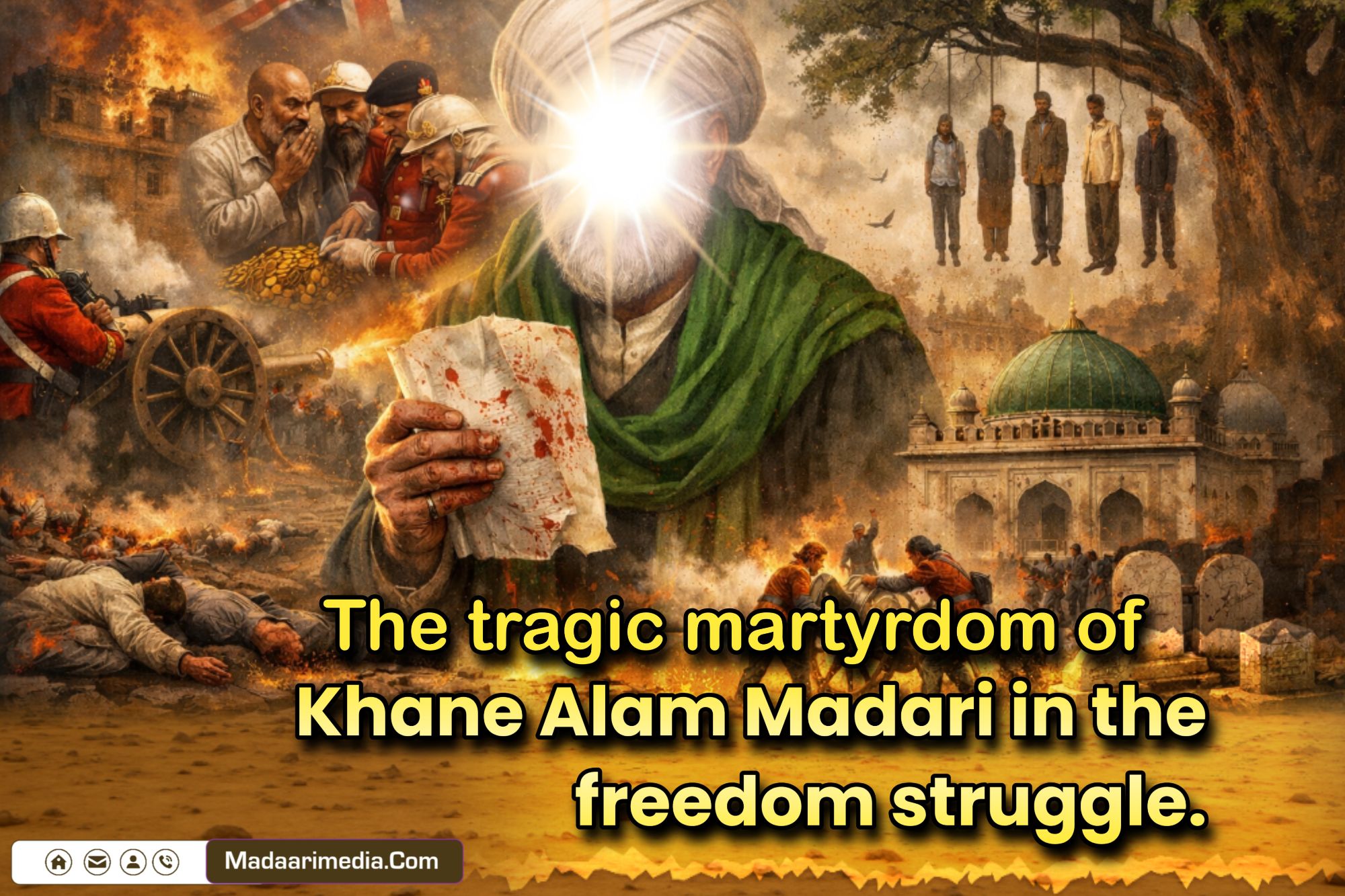
In 1857 CE, rebellions were raging across the country against British rule. In Makanpur Sharif, Martyr Sayyid Ruh-ul-Azam Miyan (may Allah have mercy on him) shot Peter Maxwell. Deeply affected by these events, Sayyid Khan Alam Miyan sent a letter against the British government to his friend Peshwa Nana Rao.
However, traitors to the nation were not few. Tamizuddin, Jhabbū Ghulam, Chhida, and Azam—these four individuals whispered into the ears of British rulers and handed over the letter to the colonial government. As a result, the mouths of British cannons turned toward this small settlement, and the English rulers unleashed such mountains of oppression and brutality that this area suffered economic and financial devastation for a very long time.
These four traitors were rewarded by the British government with parcels of land, which were later auctioned.
The English rulers mercilessly blew Martyr Sayyid Ruh-ul-Azam Miyan and Shah Nattha Miyan apart with cannons. The entire mansion of Martyr Sayyid Khan Alam Miyan was demolished. The library located there was set on fire, and all the books were reduced to ashes. The greatest cruelty was that thirty members of Sayyid Khan Alam’s family were also hanged from the tamarind tree.
Today, the graves of those thirty individuals appear to narrate, through silent testimony, the story of their innocence and their sacrifice of life for the nation. The shrine of Sayyid Ruh-ul-Azam Miyan is located at the northern gate of the shrine, and the shrine of Shah Nattha Miyan stands at the southern gate.
The mansion and all properties of Sayyid Khan Alam Miyan were looted, and his family members were mercilessly expelled from the mansion. Thus, the British government seized possession of the property.
Historical documents record that the British government auctioned the mansion of Martyr Sayyid Khan Alam Miyan. Sayyid Khan Alam Miyan protested British oppression and barbarity along with some of his fellow freedom fighters, as a result of which he sustained severe injuries.
History records that after the failure of the First War of Independence, it remained unknown where Peshwa Nana Rao went from Bithoor. Later, news of his death emerged, stating that he passed away at the age of only 35 years, on 24 December 1859 CE, at an unknown location.
During this period, Sayyid Khan Alam Miyan, in a severely wounded condition, reached Alwar, within his circle of disciples. From there, he sent a letter written with his own blood to Makanpur Sharif.
The tragic incidents described in that blood-written letter cause one’s soul to tremble upon reading them. For a long time, that letter remained preserved with our elders, and we heard detailed accounts of these events and tragedies from them. Sadly, with the passage of time, we have been deprived of witnessing those historical documents.
It is a separate matter that the martyrs of the First War of Independence of 1857 CE were forgotten. With the failure of that war, the people of the country forgot those favors and sacrifices, by virtue of which, exactly ninety years later, in 1947 CE, the British were forced to leave this land and India was freed from the grip of foreign oppression.
However, whenever the history of India’s freedom is written, the world will continue to remember the sacrifices of Sayyid Khan Alam Miyan and the people of Makanpur Sharif. We present our tribute of loyalty and reverence to these martyrs of the nation.
Author:
Maulana Sayyid Muqtada Hussain Jafri