- Fast recitation of Quran
- Reciting Quran quickly in Taraweeh
- Taraweeh Quran recitation speed
- Is fast Quran recitation allowed
- Taraweeh prayer Quran recitation
- Quran recitation in Ramadan
- Completing Quran in Taraweeh
- Benefits of Quran recitation
- Tajweed and Quran recitation
- Quran recitation during Taraweeh
What is the ruling on reciting the Qur’an quickly?
Every year, videos of some scholar or an ordinary person circulate in which Taraweeh prayers are criticized in one way or another. The purpose behind this is that Muslims may move away from Taraweeh. Some people have already reduced the twenty rak‘ahs to eight, even though Islam gave us twenty rak‘ahs of Taraweeh and the Prophet of Islam (peace be upon him) granted us the practice of twenty rak‘ahs. Some people have reduced them to eight, while others now want to abolish them completely.
The reality is that Islam has been suppressed by such people even more than by non-Muslims. They claim to be Muslims outwardly but inwardly they lack faith. Such people are a great cause of concern.
First, let me explain something. A claim is often made that the Qur’an should not be recited quickly; rather it should be recited very slowly, calmly, and with full tajweed, just as people recite it in prayer:
Bismillāhir-Raḥmānir-Raḥīm Al-ḥamdu lillāhi Rabbil-‘Ālamīn
They say it should be recited slowly like this.
Allah Almighty says in the Holy Qur’an. You just heard a verse from Surah Al-Muzzammil:
“Or add to it and recite the Qur’an with measured recitation.”
Yes, the Qur’an should be recited with deliberation and measured recitation. Why? Because the Qur’an that has been given to us has a purpose. And what is that purpose? That we read the Qur’an and gain religious knowledge and guidance from it. This is the objective of the Qur’an. Therefore, the Qur’an should be read slowly, thoughtfully, and with understanding. This is the command of Allah.
In our madrasas this also happens. In gatherings and religious assemblies this also happens. In gatherings of Milad as well, the Qur’an is recited and then explained. A verse is recited and its meaning, explanation, context of revelation, and lessons are explained so that people may understand the teachings of the Qur’an.
However, there are two ways of reciting the Qur’an. One is to recite it in order to gain knowledge, and the other is to recite it in order to gain blessings.
For example, when you send your child to a madrasa to learn the Qur’an, the purpose is education so that the child learns the Qur’an.
But when someone passes away in your home, people recite the Qur’an, students from the madrasa are invited to recite the Qur’an, neighbors gather and recite the Qur’an, and women in the house also recite the Qur’an. Are they reciting it for education? Are they reciting it to learn the Qur’an? No. They recite it solely to obtain blessings and reward.
At that moment, the purpose is not to study the Qur’an in order to learn religion. Rather, the intention is to receive blessings.
Therefore, there are two approaches to reciting the Qur’an and two benefits: one is acquiring knowledge and the other is gaining blessings.
The Qur’an that is recited in madrasas and religious gatherings is for education. But the Qur’an that is recited in Taraweeh is for obtaining blessings.
Now, there is no problem in reciting it quickly, because most people do not understand Arabic. Even if the Qur’an is recited slowly and at length, people will not gain knowledge from it unless its translation and explanation are given.
Therefore, the Qur’an recited in Taraweeh, or when women recite it at home, or when we ourselves recite it in daily recitation, is mainly for obtaining blessings from the Qur’an.
For example, Sayyiduna Khwaja Moinuddin Chishti (may Allah be pleased with him) is reported to have performed the Fajr prayer with the same ablution as the ‘Isha prayer for approximately twenty-four years, and every night he would complete the recitation of the entire Qur’an.
Likewise, Sayyiduna Shaykh Abdul Qadir Jilani (may Allah be pleased with him) is reported to have prayed Fajr with the ablution of ‘Isha for approximately thirty-two years and would complete one Qur’an every night.
Similarly, the great Imam whose school of thought we follow, Sayyiduna Imam Abu Hanifa (may Allah be pleased with him), performed the Fajr prayer with the ablution of ‘Isha for forty years and completed the recitation of the Qur’an every night.
Now someone should explain: with what style of recitation did Imam Abu Hanifa recite? With which mode did Khwaja Gharib Nawaz and Shaykh Abdul Qadir Jilani recite, if they completed the entire Qur’an in one night?
If they recited in an extremely slow manner like:
Bismillāhir-Raḥmānir-Raḥīm Al-ḥamdu lillāhi Rabbil-‘Ālamīn
then even fifteen nights would not be enough to complete the Qur’an.
Obviously, they would recite it in a flowing manner.
I have not personally seen Khwaja Gharib Nawaz or Imam Abu Hanifa reciting the Qur’an, but I did see my respected father, Hazrat Mujaddid Muradabadi Imam Syed Muhammad Intesab Husain Qadri Ashrafi Madari (may Allah be pleased with him), reciting it. When he would travel by train from Delhi to Surat, Bombay, or Hyderabad—a journey of ten, twelve, or fourteen hours—he would complete at least one full recitation of the Qur’an during the journey.
This was the way of the pious elders: they recited the Qur’an for education and also recited it for blessings.
Therefore, when some people say that the Qur’an should only be recited slowly and thoughtfully, these statements often come from those who are not themselves memorizers of the Qur’an. In fact, many speakers on stages are not even Huffaz. Some may have memorized the Qur’an under pressure in childhood but later they forget it because they do not revise it.
Such people do not know the struggle of a Hafiz. They do not understand the effort and hardship required to memorize the Qur’an. Yet, just before Ramadan they begin criticizing the Huffaz, saying that they read too fast or that they take payments.
Meanwhile, many speakers in India charge large amounts for their lectures—sometimes even one hundred thousand rupees for a single speech—while simply narrating stories and unreliable reports.
They do not understand the importance of the Huffaz, nor the difficulties they face.
Therefore, whether the Qur’an is completed in six days or ten days during Taraweeh, it is perfectly acceptable. The purpose in Taraweeh is not to teach the translation of the Qur’an but to obtain blessings and mercy from its recitation.
If someone wishes to understand the Qur’an deeply, then they should study it with explanation and reflection—learning the meanings, context, and lessons of each verse. After Eid, one can sit down daily and study even one page with explanation.
But Taraweeh prayers are primarily for obtaining blessings.
So do not be misled by those who criticize fast recitation. Reciting quickly is actually very difficult.
For example, when you drive a car at forty or fifty kilometers per hour, you can easily look around and even talk to others. But when you drive at one hundred forty, you must concentrate fully; even a slight mistake can cause an accident.
Likewise, fast recitation requires great focus and skill.
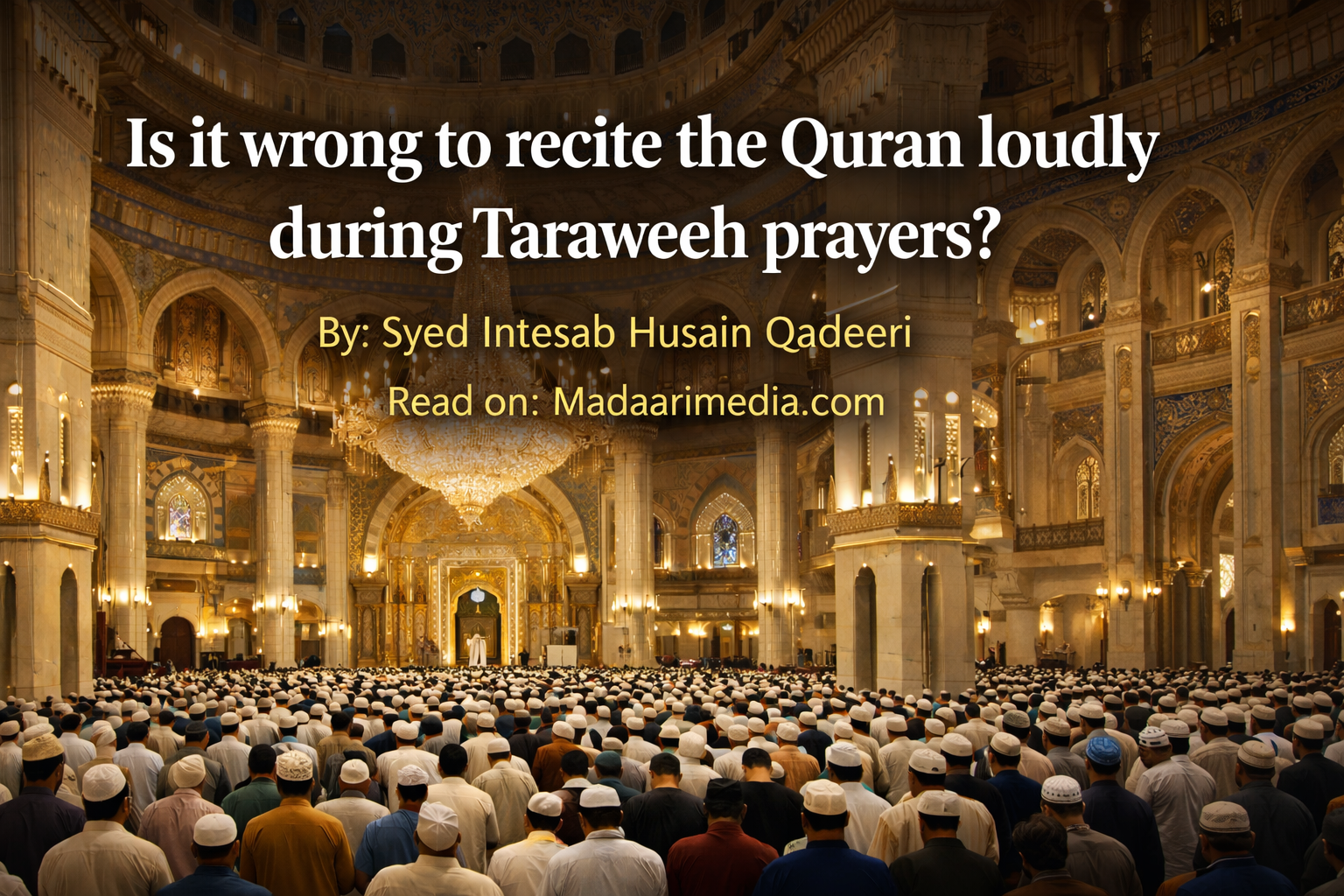
Alhamdulillah, I have travelled across many places in Ramadan—Muradabad, Maharashtra, Gujarat, Hyderabad, Delhi—and I have observed Taraweeh prayers in many mosques. But the peace and discipline with which Taraweeh is performed in Takht Wali Masjid is rarely seen elsewhere.
In many mosques, some people do not even join the imam properly in prayer. They sit until the imam reaches rukū‘ and then suddenly join. But in this mosque, almost everyone stands with the imam from the beginning and listens attentively.
Therefore, scholars should guide the people that Taraweeh should be performed properly and with respect. Instead of discouraging it, they should encourage people to establish it.
Yet some scholars only post travel updates from airports but rarely mention performing Taraweeh in a mosque.
If asked, they say they pray it at home.
If Taraweeh is prayed at home, then at least scholars should still understand the struggles of the Huffaz and respect their efforts.
In any case, this was an issue that needed clarification.