Name:
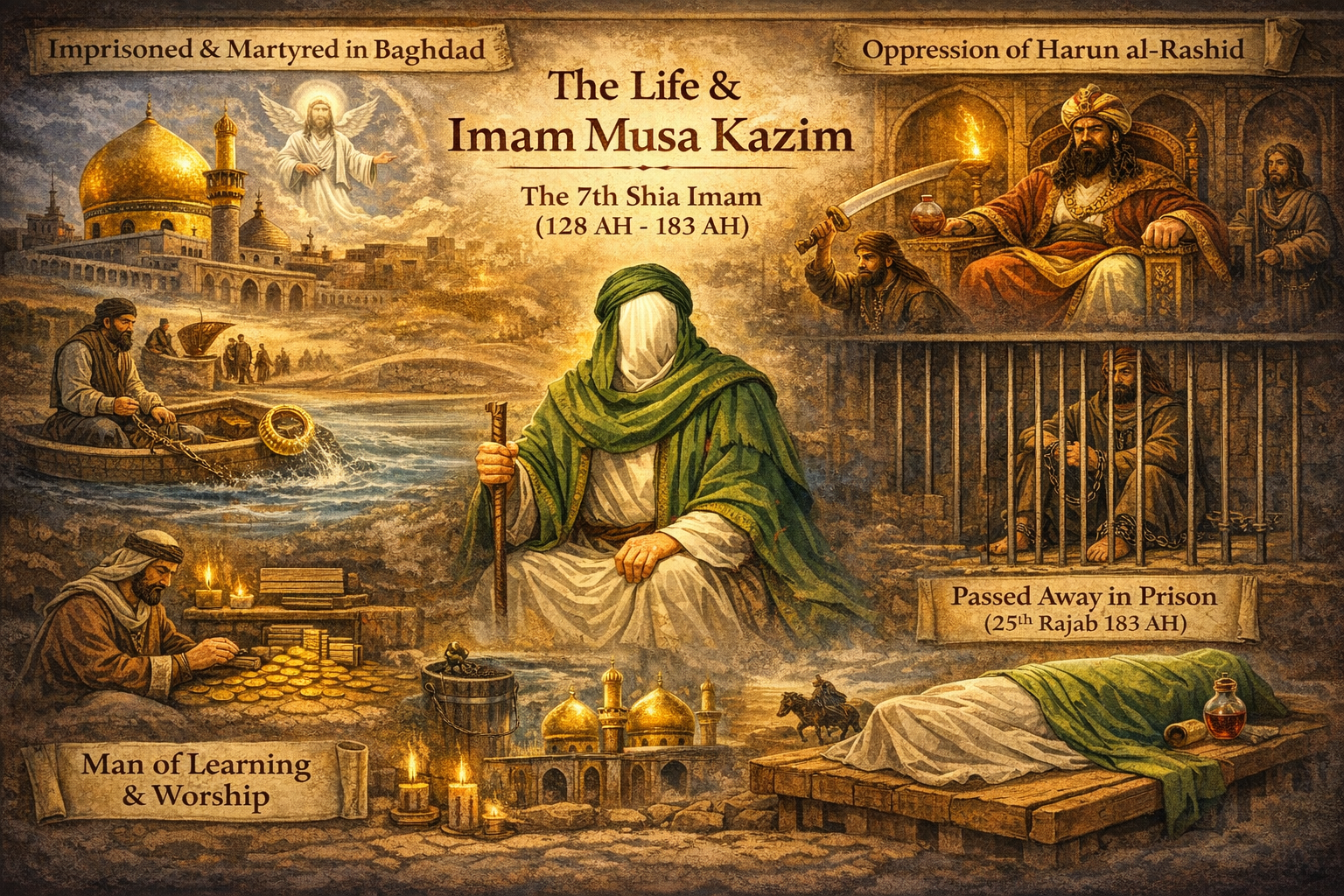
Imam Musa Kazim’s name is Musa. His kunyah is Abul-Hasan, and his titles are Sabir, Saleh, and Ameen; however, Kazim is the most well-known. In Arabic, Kazim means “one who swallows anger,” and you were given this title because the quality of restraining anger was present in you to an exceptional degree. Those who committed excesses against you were forgiven by you; rather, even more than that, after their wrongdoing you would continue to treat them with kindness and good conduct. This blessed habit remained with you throughout your life. According to Shawahid-e-Nubuwwat, you forgave those who crossed limits.
Day and Year of Birth:
Imam Musa Kazim was born on a Sunday. Nine nights of the month of Safar-ul-Muzaffar had passed, and it was the year 128 Hijri.
Place of Birth:
The birth of Hazrat Imam Musa took place at the place called Abwa, which lies between Makkah Mukarramah and Madinah Munawwarah.
Lineage:
Father: Hazrat Ja‘far Sadiq bin Muhammad Baqir bin Ali bin Husain bin Ali bin Abi Talib.
Mother: The mother of Imam Musa Kazim (peace be upon him) was Umm-e-Walad Hamidah Barbariyyah. In terms of lineage, you were Qurayshi, Hashimi, Alawi, and in terms of association, you were Madani.
Books are filled with the virtues and merits of Imam Musa Kazim (peace be upon him). You were among the greatest worshippers, jurists, forbearing, and generous people of your time. All authors who have written about your character have especially mentioned your virtues and distinctive qualities. You were the greatest worshipper of your era, the greatest scholar, the most generous, and the most honorable human being. You were the truthful and trustworthy Imam of the Muslims and a personality of exalted rank. You possessed a very high level of intellect and understanding and were adorned with worship and piety.
Scholarly Status:
According to Nuruddin Ali bin Muhammad bin Ahmad Ibn al-Sabbagh al-Maliki, you were the greatest scholar of your time.
Your scholarly status can also be understood from the dialogue that took place with Harun Rashid. He asked you: How do you claim that you are the descendants of the Messenger of Allah ﷺ, and how do you allow people to address you as “O sons of the Messenger of Allah,” whereas you are the descendants of Hazrat Ali? The rule is that a person is attributed to his father, not to his maternal grandfather.
In reply, you recited A‘udhu billah and Bismillah, and then recited these verses:
“And We had guided Noah before, and among his descendants were David, Solomon, Job, Joseph, Moses, and Aaron. And thus do We reward the doers of good. And Zechariah, John, Jesus, and Elijah—each one of them was among the righteous.”
(Al-An‘am: 84–85)
Translation:
And We had already guided Noah, and from his progeny We guided David, Solomon, Job, Joseph, Moses, and Aaron (peace be upon them). And thus do We reward those who do good. And We also granted guidance to Zechariah, John, Jesus, and Elijah (peace be upon them). All of them were among the righteous.
Observe that in these verses Allah the Exalted has counted Hazrat Isa (peace be upon him) among the descendants of Hazrat Nuh (peace be upon him), even though Hazrat Isa had no father at all. He was included among the descendants of the prophets only through his mother. In exactly the same way, we too are included among the descendants of the Noble Prophet ﷺ through our mother (Hazrat Fatimah al-Zahra, peace be upon her).
After this, you said: O Harun Rashid! I will give you another proof. Allah the Exalted says in the Noble Qur’an:
“So say: Come, let us call our sons and your sons, our women and your women, and ourselves and yourselves…”
(Aal-e-Imran: 61)
Translation:
(O My Prophet!) Say to these Christians: Come, let us call our sons and your sons, our women and your women, and ourselves and yourselves.
In this event of Mubahala, the Prophet ﷺ addressed the Christians and said: You call your sons, and I will call my sons. Accordingly, he ﷺ called only Hazrat Imam Hasan and Husain as his sons. From this it is established that Hazrat Imam Husain is the son of the Prophet ﷺ, and we are the sons of Hazrat Imam Husain; therefore, we too are included among the sons of the Messenger of Allah ﷺ.
Christians Accepting Islam Through Scholarly Arguments:
In the land of Syria there lived a monk (a Christian scholar) whom the Christians greatly respected and honored, and among them he was regarded as a very great scholar. Every alternate day he would come out of his place of worship and deliver a discourse to a gathering of people, and they would listen to him with great attention. One day, when it was the day of his discourse, Hazrat Imam Kazim also arrived there. Seeing him, the monk said: “Hey! Are you a stranger?”
You replied: “Yes!”
The monk said: “Are you from among us or from among our opponents?”
Imam Kazim said: “I am not from among you.”
The monk asked: “Are you from the ‘saved community (that is, of the Prophet ﷺ)’?”
Imam Kazim said: “Yes!”
The monk asked: “Are you among the scholars of this community or among its ignorant ones?”
Imam Kazim said: “I am not among its ignorant ones.”
Hearing this, the monk was impressed and moved closer to you in order to ask some questions which, in his view, were the most complex. He said:
The monk asked: “What is the nature and form of the Tuba tree whose root, according to us, is in the house of Hazrat Isa (peace be upon him), and according to you, in the house of Hazrat Muhammad ﷺ, and whose branches reach the house of every believer? (The purpose of the question was to clarify how it is possible that one thing remains in one place while what emerges from it reaches everywhere.)”
Imam Kazim replied: “It is exactly like the sun: its light reaches everywhere, although it itself remains in the sky.”
The monk asked: “What is the nature of that Paradise about which it is said that its food will never be exhausted, even though the people of Paradise will keep eating from it? How will it not diminish despite being consumed?”
Imam Kazim replied: “It is like a lamp in this world: it gives light, people make use of its light, yet the light does not decrease.”
The monk asked: “In Paradise there will be zill-e-mamdood (an extended shade). What is that?”
Imam Kazim replied: “The cool and pleasant time before sunrise is the zill-e-mamdood.” Then you recited this verse:
‘Have you not seen your Lord—how He extends the shade? And if He willed, He could have made it still. Then We made the sun its guide.’
(Al-Furqan: 45)
The monk asked: “The people of Paradise will eat and drink, yet they will not need to urinate or defecate—how will that be?”
Imam Kazim replied: “It will be like a child in the mother’s womb.”
The monk asked: “Will the people of Paradise have such servants who will present their desired things to them without their even speaking?”
Imam Kazim replied: “Here in this world, when a human being needs something, his limbs themselves understand it; their servants will understand in the same way.”
The monk asked: “Is the key to Paradise made of gold or silver?”
Imam Kazim replied: “The key to Paradise is this statement of a human being: La ilaha illallah Muhammad Rasulullah.”
After hearing all this, the monk said: “You have spoken the truth.” Thereafter, the monk and all those who were with him recited the declaration of faith and became Muslims.
Ready-Witted Reply:
When Harun Rashid went for Hajj, he presented himself for the visitation of the grave of the Prophet ﷺ. Along with him were the nobles of Quraysh and chiefs of various tribes. Hazrat Musa Kazim was also with him. When Harun Rashid reached near the sacred grave, he greeted in this manner to boast before those accompanying him:
“Peace be upon you, O Messenger of Allah, O son of my uncle!”
That is, he referred to the Prophet ﷺ as his cousin.
After this, Hazrat Musa Kazim stepped forward toward the blessed grave and said:
“Peace be upon you, O my father!”
Hearing this, Harun Rashid’s face turned pale, and addressing you he said:
“O Abul-Hasan! Indeed, this is something to be proud of.”
Meeting with Imam Abu Hanifa:
When Imam Kazim met Imam Abu Hanifa for the first time, he said to him: “Are you the jurist ‘Nu‘man’?”
He replied: “Yes. But how did you recognize me?”
Imam Kazim replied by reciting this verse of the Noble Qur’an:
‘Their marks are on their faces from the effects of prostration.’
(Al-Fath: 29)
Translation:
Their signs are evident on their faces from the marks of prostration.
Worship and Spiritual Discipline:
You were known by the beautiful title “Abd-e-Saleh” (the righteous servant), to the extent that you were regarded as the greatest worshipper of your time.
Such was the state of your worship that, due to the abundance of prostrations, your knees became hard like those of a camel. Therefore, because of this great frequency of prostration, just like your noble forefather Imam Zayn al-Abidin, you too were remembered by the title “Dhu’l-Thafanat” (the one with hardened knees). When you would stand before Allah for prayer, an extraordinary state would overcome you: tears would begin to flow from your eyes, your heart would tremble, and the same condition would occur when you were engaged in supplication and intimate prayer with your Lord. Your tongue would always remain busy in the remembrance of Allah.
Once, a person saw you in the last part of the night with your head placed in prostration, and these words of humility and self-effacement were flowing from your lips:
Translation: “O my Lord! The sins of this servant of Yours have become very many; forgive him through Your grace.”
Even when you were imprisoned, there was no change in your day-and-night worship. Thus, during the period when you were imprisoned by Harun Rashid, the woman appointed to serve you in the prison narrated an eyewitness account of your worship in this manner: After performing the ‘Isha prayer, you would remain engaged in supplications and remembrances until late at night. When a large portion of the night had passed, you would rise and begin offering supererogatory prayers, continuing until the time of the Fajr prayer arrived. After performing the Fajr prayer, you would remain engaged in the remembrance of Allah until sunrise. After completing the Ishraq prayer, you would sit there again until the day had advanced, devoted to worship. When the day had progressed, you would use the miswak and partake of food, then rest until noon. Thereafter, from Zuhr until ‘Asr you would remain engaged in supererogatory prayers; after ‘Asr until Maghrib you would remain occupied with remembrances; and between Maghrib and ‘Isha you would again offer supererogatory prayers. This routine continued until your passing.
Generosity and Compassion:
Imam Musa Kazim (peace be upon him) was the most generous person of his time. In Iraq, you were famously known as “Bab al-Hawa’ij” (the Gate of Needs), because whoever came to you with a need never returned empty-handed. Rather, you yourself would seek out those in need, especially making special inquiries about the poor of Madinah, and in such a manner would deliver money and necessary provisions to their homes that they would not even know where all of it had come from. Only after your passing did this secret become known.
Once, a slave presented you with “harirah” (a sweet prepared from flour and clarified butter) as a gift. You then purchased both that slave and the agricultural land on which he worked from their owner for one thousand dinars (equivalent to approximately one and three-quarter crore rupees). Thereafter, you set the slave free and also gave him that land.
A ninety-year-old elder, Abu Mugheeth Qurzi, relates: I had cultivated watermelons, cucumbers, and pumpkins near a well called Umm-e-Izam in Jawaniyyah. When the crop had ripened and the time for income was near, one night locusts came and devoured the entire field, although I had already spent one hundred and twenty dinars on the crop and on purchasing two camels for the work. I was sitting in this distress when Hazrat Imam Kazim arrived, greeted me, and asked about my condition. I said: I have become destitute; last night locusts came and wiped out my entire field. He asked: How much loss have you suffered? I replied: If the price of the two camels is included, the total comes to one hundred and twenty dinars. He then gave me one hundred and fifty dinars and said: Thirty dinars and the two camels are from us as your profit.
Occurrence of Wonders and Extraordinary Events:
Hazrat Shafiq Balkhi narrates that during the journey of Hajj I reached the land of Qadisiyyah. There I saw a handsome, tall young man wearing woolen garments. A shawl was draped over his shoulder and sandals were on his feet. Emerging from among many people, he came and sat alone at one place. I thought to myself that this young man seemed to belong to the class of Sufis and perhaps wished to become a burden on the Muslims during this journey. Therefore, it was necessary that I go and admonish him so that he might refrain from this. As soon as I approached him, he said:
“O Shafiq! Avoid much suspicion, for indeed some suspicions are sins; and do not spy, nor backbite one another.”
Saying this, he went away. I thought to myself that this was a strange matter: he mentioned my name and disclosed what was in my heart. This must be an extremely pious man. I should seek forgiveness from him. I tried hard to walk fast, but I could not reach him.
When we reached the next stage, I saw him engaged in prayer. His body was trembling and tears were flowing from his eyes. Again I wished to ask his forgiveness. After waiting a short while, I moved toward him. He said: “O Shafiq, recite this verse”:
“And indeed, I am surely Forgiving to one who repents, believes, does righteous deeds, and then remains guided.”
Saying this, he left me and went away. I understood that this young man was among the abdal (spiritual substitutes), for he had disclosed the thoughts of my heart twice.
When we reached another place, I saw him standing at a well. In his hand was a leather bucket with which he wanted to draw water, but the bucket slipped from his hand and fell into the well. He turned his face toward the sky and said:
“Indeed, my Lord [is sufficient for me] when the water darkens and my strength when I desire nourishment. O Allah, direct it back to me and do not withhold it.”
The narrator says: By Allah! I saw the water rise upward. The young man stretched out his hand, lifted the bucket from the surface of the water, performed ablution with it, and then offered four units of prayer. Then he went toward a sand dune, took a handful of sand, put it into the bucket, stirred it well, and drank from it. Seeing this, I went to him and said, “Peace be upon you.” He replied, “And peace be upon you.” I said: Feed me, for Allah the Exalted has granted you much. The young man said: “O Shafiq! The outward and inward blessings of Allah the Exalted continue to reach me always; therefore, maintain good thoughts about Allah.”
Then he gave me the same bucket from which I drank. In it were parched barley flour and sugar. By Allah! I have never drunk anything sweeter or more delicious than that. I became fully satisfied and quenched, to the extent that for several days I felt no need for food or drink. After that, he disappeared from my sight.
When we reached Makkah al-Mu‘azzamah, I saw him offering the Tahajjud prayer. He was praying with great humility and devotion, and tears were flowing from his eyes. This continued throughout the night. When morning came, after the Fajr prayer he began performing tawaf. After completing the tawaf, he went outside. I followed him and saw that now many servants and attendants were with him, and people had surrounded him saying: “Peace be upon you, O son of the Messenger of Allah.” I inquired and learned that he was Hazrat Musa bin Ja‘far bin Muhammad Baqir bin Ali bin Husayn bin Ali bin Abi Talib. Spontaneously I exclaimed: From such a noble descendant, the occurrence of such wondrous and extraordinary matters is not surprising at all.
The Cloak of Ali bin Yaqtin:
Harun Rashid bestowed upon Ali bin Yaqtin very fine garments, among which was a cloak made of excellent silk. Due to the deep love that Ali bin Yaqtin had for Hazrat Musa Kazim, he sent those garments along with many other items to him. Hazrat Musa Kazim accepted all the items, but returned the cloak and said: “Keep it safe; it will be of use to you.”
A few days later, Ali bin Yaqtin became extremely angry with one of his slaves. The slave fled and reached Harun Rashid, where he said: My master Ali bin Yaqtin has accepted Musa Kazim as his Imam and has sent him a great deal of wealth; among it is a cloak that Harun Rashid himself had given my master as a mark of honor. Hearing this, Harun Rashid became furious. Immediately he sent an emissary to summon Ali bin Yaqtin. When he appeared in the court, the caliph asked: What happened to the cloak that I had given you to wear? He replied: O caliph, it is still with me. The caliph said: Present it. He summoned a slave and said: Go to such-and-such house; there is a chest there. Take its key from such-and-such maid and open it. Inside there will be a sealed container—bring it here.
After a short while, the slave brought the container. Rashid ordered the seal to be broken. When it was opened, the same cloak appeared, which had been carefully preserved with rose perfume. When the caliph was reassured, his anger subsided. He then said: Return it to its place and remain happy and content. In the future, I will never listen to anyone regarding you.
The Lost Bowl:
A man who lived as a resident near the sacred places in Madinah Munawwarah says: I had rented a house, and I spent most of my time in the service of Hazrat Musa Kazim. One day there was very heavy rain. I put on my clothes to present myself in his service. When I reached him, I said, “Peace be upon you.” He replied, “And peace be upon you.” Then he said: “O so-and-so! Go back to your home immediately, because the roof of your house has collapsed onto your belongings.” I returned and found that indeed the roof of my house had fallen. I hired some men who removed my belongings from beneath it. Nothing of mine was lost except one bowl, which I used for ablution. When he came to know of this, he remained in contemplation for a few moments and then said: “I think you left it somewhere. Go and ask the maid of the owner of your lodging whether she picked up my bowl. If she did, ask her to return it.”
I went back and said to the maid: I had forgotten my bowl at such-and-such place; you had come and picked it up. Please return it to me so that I may perform ablution. She went just as she was and brought it back and presented it.
The Bracelet Floating on Water:
The same resident relates that when Imam Musa Kazim was taken to Basra, I boarded a boat with him near Madā’in. Behind us there was another boat in which there was a woman who had just spent her wedding night with her husband. Suddenly, noise and commotion were heard from that boat. He asked: “What kind of noise is this?” I replied: “There is a bride in the boat.” After an hour passed, the noise was heard again. He asked: “What is this wailing and crying?” People replied: “The bride sitting in the boat wanted to take a little water from the river, but her golden bracelet fell into the water, and she is crying.” He said: “Take care of the boat.” The people carried out his instruction. He also said: “Tell the boatman of that boat to keep the boat secure as well.”
When the boat reached the shore, he began reciting something softly under his breath. Then he said to the boatman: “Let him tie up his garment and jump into the water and catch the bracelet.” We saw that the bracelet rose to the surface of the water, and the boatman jumped into the water and caught the bracelet.
The Separation of the Dinar:
Another narrator states that one of our companions had one hundred dinars, which he gave to me so that I might present them in the service of Hazrat Imam Musa Kazim. I also had another item with me. When I reached Madinah, after bathing and washing, I cleaned my belongings and sprinkled them with musk and other perfumes. Then, when I counted that man’s money, there were ninety-nine dinars. I counted them again and found the same number, so I added one dinar from my own pocket to make them complete.
When night came, I presented myself before him and said: “May my life be sacrificed for you, I have some money with me by which I wish to attain nearness to Allah.” He said: “Bring it.” I took the dinars to his presence and said: “One of your servants has also given me something.” He said: “Bring it.” I presented the pouch, and he said: “Place it on the ground.” I placed it there. As soon as he passed his blessed hand over it, my dinar became separated. Then he said: “I rely on weight, not on number.”
Blessing in the Travel Provision:
A narrator relates that Ali bin Yaqtin and another gentleman said to me: “Go with such-and-such person to Kufa, and from there purchase two riding animals, then deliver this letter and this wealth to the service of Hazrat Musa bin Ja‘far.” I went to Kufa and, together with that man, purchased two riding animals. When we came near Madinah Munawwarah, we stopped at one place and began eating some food. Suddenly our eyes fell upon Hazrat Musa bin Ja‘far, who was approaching mounted on a mule. We stood up respectfully and offered salutations in his noble presence. He said: “Bring whatever you have with you.” We presented everything, and then also gave him the letter. He took out some letters from his sleeve and said: “These are the replies to your letters. Return under the protection of Allah.”
I submitted: “Our travel provisions have been exhausted. If you permit, after visiting the radiant shrine of the Messenger of Allah (peace and blessings be upon him), we may also take provisions for the journey?” He said: “Is there anything left from your provisions?” We replied: “Yes.” He said: “Bring it to me.” We presented it. Taking it in his hand, he said: “This provision is sufficient for you until Kufa. Return under the protection of Allah.” According to his instruction, we returned, and even upon reaching Kufa that provision was still remaining.
Counsels and Advice:
These noble personalities of the Ahl al-Bayt were a perfect combination of knowledge and practice, and living embodiments of asceticism and piety. Therefore, their counsels and teachings contained a true spirit and a unique, lasting impact. Below are some of those soul-nourishing pieces of advice:
- It is not justice that two people participate in a crime, yet the powerful one is let go while the weak one is punished.
- Keep distance from an enemy, and even be cautious with a friend, for it is unknown when a heart may change.
- You once saw a man wishing for death. You asked him: Is there any such relationship between you and Allah because of which Allah would deal with you with ease and gentleness? He replied: No. You then asked: Have you sent ahead so many good deeds that they outweigh your sins? He replied: No. You said: Then you are wishing for your own eternal destruction.
- One whose two days are equal is deceived, and one whose second day is worse than his first has been deprived of Allah’s mercy.
- One who does not feel improvement and progress within himself is in loss, and for one who is in loss, death is better than life.
(Reported from your noble father): Always speak the truth, whether it is in your favor or against you; recite the Qur’an; spread greetings of peace; command what is good and forbid what is evil; maintain ties with those who cut them off; give to those who ask; and avoid tale-bearing, for it creates hatred and enmity in hearts.
News of Death While in Imprisonment:
A person narrates that when Hazrat Musa Kazim was summoned to Baghdad for the first time by Caliph Mahdi, you instructed me to purchase necessities of life from the market. When your gaze fell upon me, you saw me deeply sorrowful and distressed. You said: “O so-and-so! What is the matter? You appear worried.” I replied: “Why should I not be sorrowful and grieved? You are going to a tyrant, and the outcome of going to him is unknown.” You said: “Do not fear. I will return on such-and-such a date of such-and-such a month. Therefore, wait for me at the beginning of the night.”
From that day onward, I began counting the days and nights. When the appointed day arrived, my waiting proved fruitless. The sun set, yet I saw no one coming. Satan the accursed cast whispers into my heart. I became greatly frightened by these thoughts, and a severe anxiety overcame me. Suddenly, I saw a darkness approaching from the direction of Iraq, and in front of that darkness I saw the shadow of Musa Kazim, mounted on a mule, calling out:
“O so-and-so! O so-and-so!”
I said: “O son of the Messenger of Allah! I am present.”
You said: “You were close to falling into doubt and misgiving.”
I replied: “Indeed, O master, that was exactly the case.”
Then I said: “All praise is due to Allah! You have been delivered from that tyrant.”
You said: “He will summon me once again, but this time I will not be granted deliverance.”
The First Imprisonment and Release:
Imam Musa Kazim was imprisoned for the first time in Baghdad by the order of Mahdi ibn Mansur. One night, Mahdi saw Hazrat Sayyiduna Ali (may Allah honor his face) in a dream, saying:
“So would you perhaps, if you were given authority, cause corruption on the earth and sever your ties of kinship?”
Rabee‘ says that while some part of the night still remained, Mahdi summoned me. When I arrived, I heard him reciting the above verse melodiously. Then he said to me: “Go immediately and bring Musa bin Ja‘far, may Allah be pleased with him.” I carried out the order and brought him. Caliph Mahdi embraced him, seated him beside himself, and narrated his dream. Then he said: “Can you not promise that you will not rebel against me and my children?”
You replied: “By Allah! I have no such intention, nor does it befit me to do so.”
Mahdi said: “That is correct.” Then he instructed Rabee‘: “Give him ten thousand dinars and prepare travel provisions so that he may return to Madinah.” Rabee‘ says: We made all the arrangements overnight and accompanied him to bid farewell so that no one might cause him harm. Thus, he reached Madinah safely and peacefully.
The Second Imprisonment:
The caliph summoned Imam Musa Kazim a second time from Madinah Munawwarah to Baghdad and imprisoned him. The correct account is that he passed away due to poison administered in prison, meaning that he attained martyrdom. The brief account is that Harun al-Rashid brought him from Madinah to Baghdad and confined him in prison, where he remained for a long period. It is said that Yahya bin Khalid al-Barmaki, on the order of Harun al-Rashid, mixed poison into dates and fed them to Imam Musa Kazim, resulting in his martyrdom.
Foretelling His Death and the Poisoning:
It is narrated from you that when poison was administered to you, you said: “Today poison has been given to me. Tomorrow my body will turn yellow; then half of my body will become red, then black. After that, I shall pass away.” And indeed, it happened exactly as you foretold.
Day of Passing:
Imam Musa Kazim passed away on Friday, the blessed day, corresponding to 25th of Rajab al-Murajjab, in the year 186 Hijri, while imprisoned by Harun al-Rashid.
Shrine:
The grave of Imam Musa Kazim is in Baghdad.
☆☆☆