The noble personality of Hazrat Imam Husayn (may Allah be pleased with him)—the grandson of Mustafa, the beloved son of Ali al-Murtaza, the comfort of the heart of Sayyida Fatima (peace be upon her), the Prince of both worlds—is an exalted embodiment of truth and righteousness, piety and purity, courage and bravery, patience and steadfastness, strength of faith and action, submission and contentment, obedience to the Lord, resolve and perseverance. He holds a unique position in the entire history of humanity and is of the highest historical significance. No person of intellect and understanding can deny the truth that, in the formation of any individual or nation, along with the power of faith, purity of the soul, cleanliness of the heart, noble lineage, and refined upbringing play a decisive role. With all these essentials, the greater the intensity and heat of courageous faith, the more it elevates personality to life, and life to the summit of perfection. Without this, no one can attain a distinctive status in the world, nor can any worthy identity be established.
Man is the masterpiece of the Necessary Being in the realm of creation. The reason for human nobility and superiority lies in the possession of moral character and the faculty of faith that distinguishes him completely from all other creatures. When all these qualities reach their point of perfection, then man attains that lofty and exalted station of honor and greatness, dignity and majesty, whose ultimate height cannot be comprehended without divine grace. At this moment, the intent is to mention that rare, finely crafted gem shaped by the gaze of prophethood, by whose radiance every sphere of human life is illuminated and resplendent; that blossomed flower of the garden of purity whose fragrance perfumes the senses of the universe; that mountain of steadfast courage against which the tsunami-like waves of oppression and tyranny were shattered; the crown-bearer of the kingdom of spirituality; the leader of the youth of Paradise; the spring harvest of the Fatimid garden; the radiant pearl of the treasury of prophethood; the dignified embodiment of the grandeur of Haydar-e-Karrar—Imam Husayn, of the exalted station, pure and noble, peace and blessings be upon him and his family.
The Auspicious Birth
It was the final watch of a pleasant spring night. Under the cool, merciful shade of Mustafa, the Mercy to the Worlds (peace and blessings be upon him), the air was perfumed with the echoes of Qur’anic recitation reverberating from the walls of Madinah and with the voices of sacred hymns. Hazrat Umm al-Fadl, the wife of Hazrat Abbas ibn Abd al-Muttalib (may Allah be pleased with them), was granted audience in the Court of the Messenger of Allah (peace and blessings be upon him). Signs of concern were evident upon her face. With utmost compassion, the Holy Prophet (peace and blessings be upon him) inquired about the reason for her distress. She submitted:
“O Messenger of Allah (peace be upon him), I saw a very disturbing dream last night.”
A dream so troubling that the heart trembles at its very thought. He asked, “What was it? Relate the dream.” She replied, “O Messenger of Allah, it was extremely frightening.” He said, “Relate it—what kind of dream was it?” She said, “O Messenger of Allah (peace be upon him), I saw that a piece was separated from your blessed body, and that piece came into my lap.”
Upon hearing this, the Holy Prophet smiled and said:
“You have seen goodness. Fatimah, God willing, will soon give birth to a son, and he will be in your lap.”
The Knower of the unseen, the Prophet of Allah (peace be upon him), said: “Aunt, glad tidings to you—you have seen a very good dream. God willing, soon a prince will be born in the house of the Princess of both worlds, Fatimah al-Zahra (peace be upon her), and you will hold him in your lap.”
Some time after this glad tiding from the prophetic tongue, within the embrace of Fatimah (peace be upon her), that embodiment of beauty and light manifested. Along with the assemblies of stars, even the sun and the moon bowed to receive alms of his beauty and radiance.
It was the fourth year after the Prophetic Migration, and the fifth day of Sha‘ban al-Mu‘azzam, when in the pure embrace of Sayyida of the Universe, Fatimah al-Zahra (peace be upon her), the grandson of the Messenger of Allah ﷺ, the exalted Imam Husayn (may Allah be pleased with him), manifested himself. In the entire universe, this alone is that pure household whose purity and sanctity are testified to by the Holy Qur’an itself. History bears witness that when the glad tidings of his blessed birth reached the Truthful Informer, the Messenger of Allah ﷺ, he swayed with joy and happiness. He honored the house of Sayyida Fatimah (peace be upon her) with his presence, took the newborn into the embrace of mercy, recited the Takbir and the Iqamah, and placed his blessed saliva into the infant’s mouth as the first nourishment. He then chose the name Husayn.
The world knows that in this world of clay and water, when a newborn takes its first step into life, it possesses no personal identity of its own. Rather, people ask: What is his father’s name? Who is his grandfather? What is his lineage? From which family is he the illuminating lamp? What services has this family rendered to society? By which achievements has the community been influenced by this household? These are the references that usually accompany any individual from birth to the last breath of life and become part of his personality. This eternal honor and distinction belongs only to Husayn the Pure, that he is the last grandson of the Chief of the Prophets ﷺ, and the noble son of that revered father whose forehead was never polluted by a prostration to anyone other than Allah; whose every breath was imbued with the fragrance of devotion and divine intimacy; who was granted the everlasting title of Gate of Knowledge; whose sacred being is such a fountainhead of courage and bravery, piety and purity, that until the Day of Resurrection, fortunate and thirsty souls will continue to be quenched from it.
Husayn the Pure appeared in that embrace of chastity and purity upon whose modesty and sanctity even the maidens of Paradise take pride; whose mantle of purification is a corner of the shade of Paradise; that princess of the kingdom of love around whose doors and walls Jibril the Trustworthy circumambulates; whose sanctity is such that—
Even Jibril does not enter Husayn’s home without permission; Those who possess true worth know the rank and dignity of the Ahl al-Bayt.
The true excellence and uniqueness of the Pure Imam lies in the fact that despite possessing such magnificent ancestry and exalted references, he preserved his own singular individuality—an individuality without any substitute. What was impossible, Husayn the Pure made possible. This is his unique distinction and exclusive honor alone. To be the son of a great father, the child of an exalted mother, the radiant lamp of a noble lineage, and a member of a glorious household is undoubtedly a blessing—but for a person of capacity, these are also trials and tests. To uphold the dignity of a great father, to fulfill the right of the upbringing and merciful embrace of a noble mother, to safeguard the honor and esteem of the family, and to protect the grandeur and majesty of the household—tasks that are fulfilled only through being imbued with the Divine Color—are no ordinary matters. Husayn the Pure is among the most unique personalities in human history; despite centuries passing, he is still read, studied, and understood today. Those devoted to research and inquiry seek him; those who love him are restless to reach the ultimate heights of devotion.
Thus, the merciful embrace of the Messenger of Islam ﷺ— which was the very academy of Islamic training—became wholly engaged in nurturing his grandsons with utmost affection and tender care. Islam and the two princes shared the same cradle in which they were raised and nurtured. On one side was the Messenger of Allah ﷺ, whose very purpose of life was the perfection of human morals; on the other was the Lion of Allah, Ali (may Allah be pleased with him), who through his character and actions had already become the beloved of the Divine Will; and on the third side was the Princess of both worlds, Sayyida Fatimah al-Zahra (peace be upon her), who among all women was chosen by Divine Wisdom to convey the mission and purpose of prophethood. In this radiant environment, Husayn the Pure was raised and nurtured.
The Messenger of Allah ﷺ loved both grandsons immensely—sometimes seating them upon his blessed chest, sometimes lifting them upon his honored shoulders—and he would instruct the Muslims to love them, declaring that love for them is a sign of success in both worlds. However, his expressions of love for the younger grandson were especially unique. When, during prayer, Husayn climbed onto his blessed back while he was in prostration, he prolonged the prostration until the prince descended of his own accord; only then would the Prophet ﷺ raise his blessed head. At times, while delivering a sermon, Husayn would enter the mosque and accidentally fall to the ground; the Messenger of Allah ﷺ would stop the sermon, lift the prince into his embrace, ascend the pulpit, and proclaim: “O Muslims! Behold, this is Husayn. Recognize him well and remember his virtue: ‘Husayn is from me, and I am from Husayn.’”
Sayyiduna Imam Husayn (peace be upon him) was nurtured for approximately six years and six months under the affectionate shade of the Messenger of Allah ﷺ. The Noble Prophet ﷺ showed extraordinary love and compassion toward Hasan and Husayn, and all the Companions, following the example of the Messenger ﷺ, also expressed special affection and reverence for the two noble princes. After the blessed passing of the Messenger of Allah ﷺ, the Caliph of the Prophet, Hazrat Abu Bakr Siddiq; the Commander of the Faithful, Hazrat Umar al-Faruq; and Sayyiduna Uthman Ghani (may Allah be pleased with them all) continued to hold the noble princes Hasan and Husayn in the highest esteem, preferring them even over their own children.
On one occasion, Hazrat Abdullah ibn Umar (may Allah be pleased with them both) wished to know from his father, the Commander of the Faithful Hazrat Umar al-Faruq (may Allah be pleased with him), the reason for the special honor and distinction accorded to Hasan and Husayn. Hazrat Umar asked his son: “Tell me—Is your mother like their mother?” He replied, “Certainly not.” He asked, “Is your maternal grandfather like their grandfather?” He replied, “No.” He asked, “Is your family like their family?” The answer again was “No.” Hazrat Umar al-Faruq (may Allah be pleased with him) then said: “My son, these are precisely the distinctions and honors that have made Husayn the Pure deserving of exaltation in both worlds. It is no small honor for me that Allah has granted me the ability to honor one who is the very symbol of closeness and love of the Messenger of Allah ﷺ.”
The Exalted Imam Husayn (peace be upon him) was extremely generous, profoundly God-fearing, devout in worship, and abundant in righteous deeds. Generosity, hospitality, care for the poor, moral refinement, forbearance, humility, patience, and piety were among his noble qualities. His devotion to prayer and his passion for reciting the Qur’an were such that even the greatest ascetics of purity envied him. He frequently observed fasts, and his enthusiasm for performing Hajj and ‘Umrah was so great that he performed nearly twenty-five pilgrimages on foot. Indeed, within his single noble personality resided an entire world of virtues and moral excellences.
Husayn the Pure opened his eyes in an environment of knowledge and piety and was raised within the Prophetic household. Therefore, he became a mine of virtue and perfection. The gate of knowledge opened in his home, and piety was mixed into Husayn’s very nature from the beginning. Thus, by his innate disposition, he was the Imam of both Shari‘ah and Tariqah in his era. All the masters of spiritual journeys have acknowledged the Pure Imam’s excellence and perfection along with all these virtues. Hazrat Ali al-Murtaza, the Gate of the City of Knowledge (may Allah be pleased with him), held an extremely exalted position in judgment and legal verdicts. Sayyiduna Husayn the Pure, after acquiring knowledge, also adorned the seat of teaching and assumed the position of issuing legal verdicts. The elders of Madinah would turn to him in difficult matters. The grandson of the Messenger, Sayyiduna Imam Husayn (may Allah be pleased with him), possessed mastery not only over religious sciences but also over the commonly practiced sciences of Arabia. His scholarly depth, wisdom, eloquence, and rhetoric can be judged from his sermons. In short, the beloved grandson of Sayyida Batul, the Exalted Imam, is a radiant and shining chapter of virtues and merits, conduct and character. Numerous blessed traditions testify to his excellence and greatness.
In the Court of the Messenger, the popularity and greatness of Hasan and Husayn were such that the Mercy to the Worlds ﷺ would frequently pray for both of them and would emphasize to the people that they should love them. He said: “Hasan and Husayn are both my sons—the sons of my daughter. O Allah, I love them, so You too love them, and love whoever loves them.” The Eternal Messenger ﷺ also said: “Hasan and Husayn are the leaders of the youth of Paradise.” That is the grace of Allah; He grants it to whom He wills.
After the passing of the Mercy to the Worlds ﷺ, for approximately twenty-five years, the period of the Lion of Allah’s seclusion was a time for the propagation and dissemination of Prophetic knowledge and for refining his princes with leadership qualities. During this time, Husayn the Pure carefully observed various unfavorable circumstances and continued to study the character and conduct of his revered father. This was the era in which he stepped into the bounds of youth and passed through the stages of full maturity. In 35 Hijri, when Husayn the Pure was thirty years old, these were the final five years of the blessed life of Hazrat Ali al-Murtaza (may Allah be pleased with him) as the Caliph of the Muslims and Commander of the Faithful. During this period, the battles of Jamal, Siffin, and Nahrawan took place. Imam Husayn participated in the support and defense of his noble father and displayed remarkable acts of bravery.
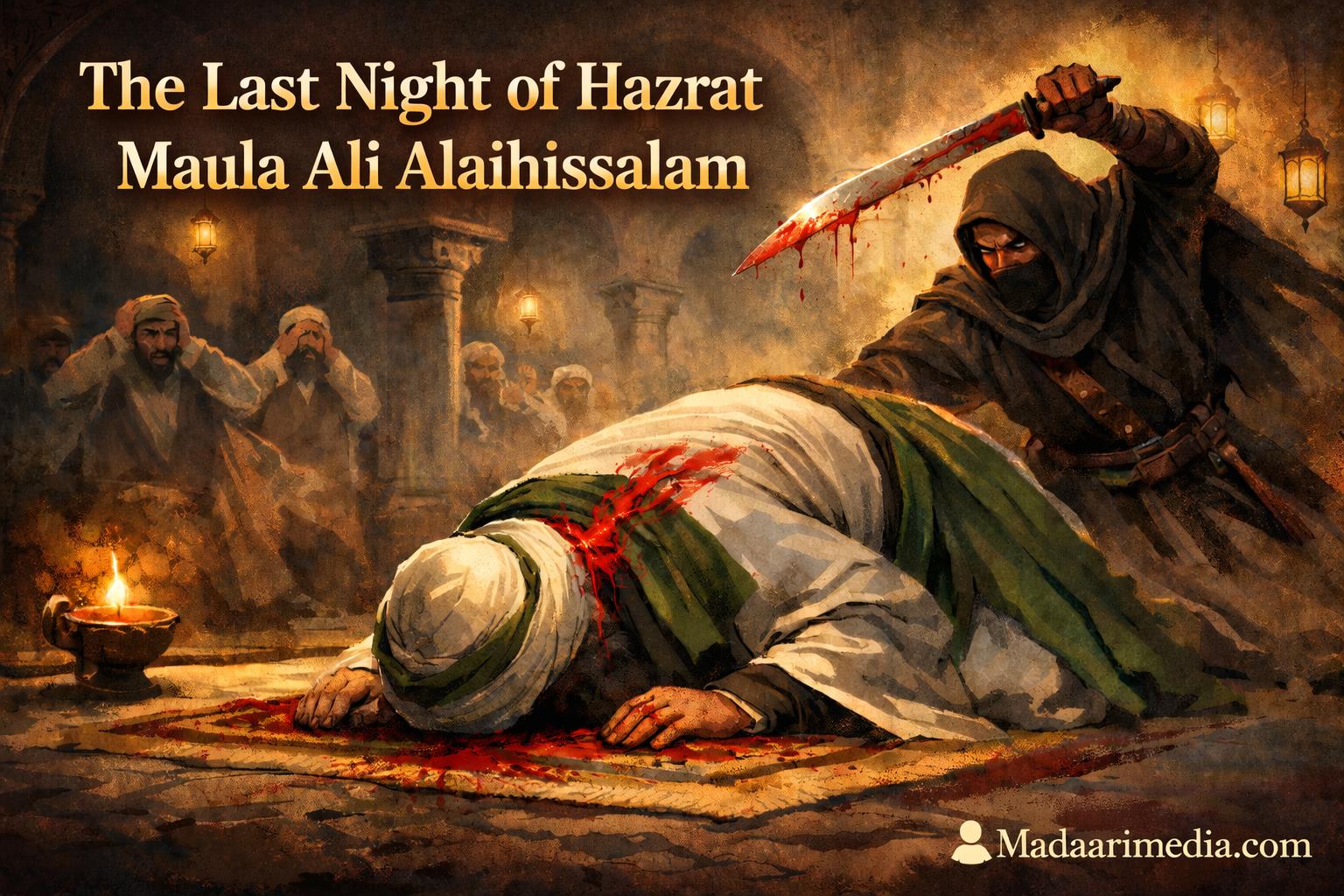
It was the fortieth year after the Prophetic Migration, the nineteenth day of Ramadan. Hazrat Ali came to the Grand Mosque of Kufa as usual and saw Ibn Muljam lying down with a sword hidden beneath him. Hazrat Ali said, “Ibn Muljam, get up; the time for prayer is passing.” That accursed man rose. Hazrat Ali performed the final prostration, and suddenly Ibn Muljam advanced and struck such a blow that the poison-soaked dagger took effect upon the blessed head. While fasting, such a severe wound was inflicted that he could not rise again. An uproar erupted in the Mosque of Kufa; it was a scene like the Day of Judgment. The lovers of Ali began to cry and wail. Hasan and Husayn came to the mosque and saw their father’s blessed beard soaked in blood and began to weep. The companions placed Hazrat Ali upon their shoulders and took him home. Chaos broke out in the house; the daughters were overcome with anguish upon witnessing the bloody scene. Physicians began treatment, but the poison had already done its work. For three days he writhed in the severity of the wound, and on the night of the twenty-first of Ramadan, Hazrat Ali answered the call of the Angel of Death.
After the martyrdom of Hazrat Ali (may Allah be pleased with him), allegiance to the caliphate was pledged at the hand of his beloved son, Hazrat Imam Hasan (may Allah be pleased with him). At that time, the situation was such that only Iraq and Khurasan came under the caliphate of Imam Hasan, while Syria, Palestine, Yemen, Hijaz, Egypt, and other regions were under the control of Hazrat Mu‘awiyah ibn Abi Sufyan al-Umawi, who had refused to pledge allegiance to Hazrat Ali due to the issue of the blood of Uthman Ghani. How, then, could he accept Imam Hasan al-Mujtaba (may Allah be pleased with him) as caliph? In Rabi‘ al-Awwal 41 Hijri, matters reached a point where Imam Hasan had more than forty thousand armed supporters, while on the other side, under the banner of Amir Mu‘awiyah (may Allah be pleased with him), an army of sixty thousand stood ready for slaughter and destruction, awaiting only a signal. Imam Hasan had witnessed Muslims being slaughtered at the hands of their own brothers during the turbulent five-year caliphate of his revered father. Therefore, to end mutual bloodshed and the never-ending cycle of killing once and for all, he withdrew himself from the field and handed over the office of caliphate to Amir Mu‘awiyah—although Imam Hasan was on the truth and was the rightful caliph of the Ummah.
When, after the death of Amir Mu‘awiyah (may Allah be pleased with him) in Rajab al-Murajjab 60 Hijri, the issue of caliphate arose again, Imam Husayn (may Allah be pleased with him)—who was not content with his father’s martyrdom and his brother’s abdication—refused to accept the caliphate of Yazid, just as earlier Amir Mu‘awiyah had refused to accept the caliphate of Hazrat Ali (may Allah be pleased with him). From here begins that role of Imam Husayn whose memory is commemorated throughout the Islamic world in the form of the Day of Ashura.
Freedom and liberty are a fundamental principle and an essential pillar for the survival of any balanced system. Freedom was among the important objectives of the Prophets—they came to grant humanity freedom and to liberate human society from Pharaoh-like systems. Freedom is something every human being instinctively recognizes. Freedom is a great blessing from God for His servants, while slavery is the greatest humiliation of humanity. Thus, Imam Husayn (may Allah be pleased with him) cast a discerning glance at his surroundings and saw that under Umayyad rule, Islamic values were being publicly mocked and the spirit of Islam was being humiliated. Islamic laws and principles were falling victim to blatant deviation. The devoted supporters of the Ahl al-Bayt were being viewed with contempt and humiliation, and for the crime of raising their voices, they were being forced to live behind the bars of oppression and tyranny.
Islamic honor and dignity stirred, and Imam Husayn rose for the elevation of truth, because the foundation of the Islamic system of governance was democratic and consultative. The eras of the Messenger of Allah ﷺ and the Rightly Guided Caliphs were the finest examples of this. The personal character of Yazid was devoid of all those qualities that Islamic law stipulates for an amir or caliph. Hunting and amusement, wine and indulgence, dance and music were his favorite pastimes. Therefore, even on a personal level, how could it be possible for Imam Husayn (may Allah be pleased with him) to accept a sinful and immoral person as a ruler? Yazid’s accession to the throne and the beginning of his rule occurred through oppression, cruelty, and political coercion. To perpetuate his illegitimate and unprincipled authority and establish permanent kingship, he adopted monarchy and dictatorship, destroying not only all state institutions established by the Rightly Guided Caliphs but also shredding consultation and democracy. He institutionalized plundering the public treasury for personal use; he promoted obscenity and immorality, wine drinking, debauchery, and gambling; from the wealth of the public treasury he built grand palaces and began keeping monkeys and dogs. Gatherings of wine and feasting commenced; bribery flourished, and scenes of royal favoritism emerged. Incompetent and ignorant people, by virtue of their wealth, began occupying high offices. In place of Islamic education and training, ignorance, illiteracy, and moral deviation became widespread. Lies, deceit, fraud, and deception became an integral part of society. Vulgar and debauched youths began hovering around him—something the Truthful Informer ﷺ had already indicated in one of his sayings. In Sahih Bukhari, narrated by Hazrat Abu Hurairah (may Allah be pleased with him), and in Fath al-Bari reported by Imam Ibn Hajar al-‘Asqalani, it is stated that the Prophet ﷺ sought refuge from the rule of such debauched youths, saying:
“O Allah, I seek refuge in You from the beginning of the year 60 Hijri and from the rule of foolish, immoral youths.”
(Al-Sawa‘iq al-Muhriqah)
After ascending the throne, Yazid demanded allegiance from Imam Husayn (may Allah be pleased with him) through the governor of Madinah. Walid ibn ‘Utbah sent a messenger to summon Imam Husayn and ‘Abdullah ibn Zubayr (may Allah be pleased with them both). Although the news of Amir Mu‘awiyah’s death had not yet become public in Madinah, both noble personalities fully understood the purpose of the summons. When allegiance was demanded from Imam Husayn, he said: “A person like me cannot pledge allegiance in secret. When allegiance is taken publicly, I will come.” ‘Abdullah ibn Zubayr took one day’s respite and departed for Makkah.
Meanwhile, Imam Husayn found himself in a grave dilemma. If he remained in Madinah, there was no option but to pledge allegiance; otherwise, the sacred land of Madinah would be stained with the blood of the oppressed. Therefore, on the 27th of Rajab, he departed for Makkah along with his family. Upon reaching Makkah, he stayed in the valley of Shi‘b Abi Talib. No sooner had he arrived than an unending stream of letters from the people of Kufa began to arrive. He sent Muslim ibn ‘Aqil to Kufa to assess the situation. Upon his arrival in Kufa, nearly twelve thousand Kufans pledged allegiance at his hand. Influenced by the emotions of the Kufans, Muslim ibn ‘Aqil invited Imam Husayn to come to Kufa.
The people of Makkah and Madinah made every effort to dissuade him from going to Kufa, as the Kufans’ previous treacherous conduct was well known. ‘Amr ibn ‘Abdullah, ‘Abdullah ibn ‘Abbas, and ‘Abdullah ibn Zubayr all advised that since Kufa was under Yazid’s rule and his armies, weapons, and resources were present there—and since the Kufans were unreliable—it would be best for him to remain in Makkah. ‘Abdullah ibn Zubayr suggested that he stay in Makkah and strive for the caliphate from there, promising collective support, but Imam Husayn did not agree. ‘Abdullah ibn ‘Abbas proposed that instead of Kufa he go to Yemen, and said that if travel to Kufa was unavoidable, he should first write to the Kufans to expel Yazid’s governors before his arrival. In response, Imam Husayn said: “O Ibn ‘Abbas, I know you are my well-wisher, but I have made my decision.” Ibn ‘Abbas then said: “If you will not accept this, at least do not take your family with you. I fear that, like ‘Uthman (may Allah be pleased with him), you may be slaughtered before your children.” Despite all these entreaties, Imam Husayn remained firm in his decision and finally departed from Makkah for Kufa on the 3rd of Dhu al-Hijjah.
During the journey, many incidents and trials occurred, but with unwavering resolve as his companion, he continued onward. Ultimately, under the leadership of Husayn the Pure, this small caravan of the Ahl al-Bayt and devoted companions halted in the plain of Karbala on the 2nd of Muharram, 61 Hijri. The very next day, ‘Umar ibn Sa‘d, with six thousand soldiers, surrounded him. According to one report, ‘Umar ibn Sa‘d was not inclined to fight Imam Husayn, so he sent Qurrah ibn Sufyan to him. Imam Husayn said to Qurrah ibn Sufyan: “If my coming is displeasing to you, I am prepared to return to Makkah.” However, Ibn Ziyad rejected this proposal and ordered ‘Umar ibn Sa‘d that if Imam Husayn did not pledge allegiance, his water supply should be cut off. It was deemed more appropriate and necessary to arrest Imam Husayn while he was under control. Upon hearing this, Ibn Ziyad changed his stance and, rebuking ‘Umar ibn Sa‘d, ordered that Imam Husayn and his companions should surrender themselves; otherwise, they should prepare for war.
The accursed Shimr arrived with a letter for ‘Umar ibn Sa‘d. This greedy wolf, in order to preserve his authority, accepted the raising of the sword against the grandson of the Messenger of Allah ﷺ. After the final attempt at reconciliation failed, the grandson of the Messenger, Imam Husayn (peace be upon him), said to his companions: “Whoever wishes to leave is permitted by me.” Thereafter, only a few devoted companions and close relatives remained—those who pledged to stand by him until their final breath. Their number was only seventy-two (72).
Imam Husayn organized this very small force. He appointed Zubayr ibn Qays to the right flank and Habib ibn Muzahir to the left, and bestowed the standard upon Hazrat ‘Abbas. Before the battle began, he supplicated before Allah, seeking steadfastness and unseen assistance to attain martyrdom. Then, to establish proof, he turned toward the enemy ranks and said: “O people, do not hasten. First listen to what I have to say, and allow me to fulfill the right of counsel upon you and to explain the reason for my coming. If you accept my excuse and deal justly with me, you will be most fortunate. But if you are not prepared for this, then it is your choice—join together with your allies and exert your full force against me. Do whatever you wish with me. Allah is my Protector, and He helps His servants.”
As soon as he reached this part of his address, cries of intense anguish rose from the tents of the women of the Ahl al-Bayt. He paused briefly and sent his brother Hazrat ‘Abbas to quiet them. When silence prevailed, he continued and said: “O people, reflect upon my lineage and see who I am. Look within yourselves and reproach your own souls. Do you think it fitting to kill me and dishonor me? Am I not the grandson of your Prophet and the son of his cousin, the first to respond to the call of Allah and believe in His Messenger? Was Hamzah, the leader of martyrs, not my father’s uncle? Do you not remember the saying of the Messenger of Allah that ‘Husayn is from me and I am from Husayn’? Was Ja‘far al-Tayyar not my uncle? If what I say is true—and it surely is—then tell me, do you find it acceptable to confront me with naked swords? And if you think I am lying, there are still among you those who heard the hadith of the Messenger of Allah about me—you may ask them. Then tell me, even with this hadith of the Prophet ﷺ before you, will you not refrain from shedding my blood?”
However, the Kufans and their leaders were unmoved by this heart-stirring address. Yet after hearing it, the blessed, thirsty soul of Hurr ibn Yazid al-Tamimi was shaken. Saying, “This is the moment of choosing between Paradise and Hell, and I have chosen Paradise,” he declared: “O followers of Yazid, cut me to pieces or burn me alive if you wish—I have come to the feet of the leader of the youth of Paradise, and I fear nothing.” After this, the battle began in the manner of individual combat.
In this, the side of the Ahl al-Bayt prevailed. Seeing this, Ibn Sa‘d ordered a general assault. The devotees of the Ahl al-Bayt faced the enemy onslaughts with the full strength of faith. One by one, the devoted sacrificed their lives to the Creator of souls; pieces of bodies were scattered across the field of Karbala, yet no one turned away from the battlefield. By midday, the lovers of Imam Husayn drank the cup of martyrdom one after another. Then came ‘Ali Akbar, ‘Abdullah ibn Muslimah, ‘Adi, the grandson of Ja‘far al-Tayyar, ‘Abd al-Rahman, the son of ‘Aqil, Qasim, the son of Imam Hasan, then Abu Bakr, and others—each entered the battlefield and irrigated the garden of Islam with the blood of their hearts.
Perceptive historians have spoken the truth: the Battle of Karbala is not merely an event, but a complete philosophy of freedom, self-respect, courage, bravery, sacrifice, patience, and steadfastness. In this trial and suffering, the role of young children is as significant as that of grown men and elders. The fundamental reason is that every child there was aware of Karbala—despite tender age, they kept alive the Prophetic mission and Islam. Through their innocence, courage, character, and action, they bestowed upon Islam such strength that it became an eternal example for all time and rendered the religion unconquerable.
Among these children was the pure daughter of the Leader of Martyrs, the Exalted Imam—Sayyida Bibi Sukayna (peace be upon her)—who asked her uncle Hazrat ‘Abbas, the standard-bearer (may Allah be pleased with him), to bring water for her little companions. The Yazidi army set fire to the innocent child’s garment and tore out her earrings, wounding her, yet her patience and steadfastness remained firm. Even after the martyrdom of Husayn the Pure, oppression against her reached its extreme, and she was imprisoned alone in a dungeon, yet her resolve and courage never diminished.
Another young martyr was Qasim, the son of Imam Hasan (peace be upon him), who was only thirteen years old. When Imam Husayn sent him to the battlefield, he asked: “How do you perceive death in the path of truth?” Prince Qasim replied fearlessly: “I find death sweeter than honey.” After martyring this young boy, horses were run over his body, and this piece of Imam Hasan’s heart was torn into countless fragments. The two sons of Sayyida Zaynab (peace be upon her)—‘Awn and Muhammad—were also martyred in Karbala. Filled with devotion to her brother, the sister set aside the grief of her own children and became wholly consumed by sorrow at the separation from ‘Ali Akbar, who resembled the Prophet.
The completion of Islam would never have been possible without the sacrifice of six-month-old ‘Ali Asghar. Had ‘Ali Asghar not been offered in the path of Allah, how would anyone have learned that for the survival of Islam and the truth, even the most precious possession must be sacrificed? Yet alas for that merciless community that did not even have compassion for the six-month-old grandson of the Messenger and did not quench the thirst of the thirsty infant, but instead pierced ‘Ali Asghar’s neck with arrows meant for killing. Thus, one by one—children, elders, and youth—all drank the cup of martyrdom.
Now Husayn the Pure stood alone on the battlefield. The Iraqis surrounded him from all sides, yet none dared to kill him, for no one wished that this sin be upon his own head. Finally, at the incitement of Shimr, Zar‘ah ibn Sharik al-Tamimi accepted this wretched fate and struck several blows with a sword upon his arms and shoulders. Sinan ibn Anas shot an arrow, and Imam Husayn staggered and fell. As he fell, the accursed Shimr Dhi al-Jawshan advanced toward him. Upon seeing his diseased face, Imam Husayn said: “My grandfather, the Messenger of Allah, spoke the truth when he said that I see a spotted dog who will stain his hands with the blood of my Ahl al-Bayt. O wretched Shimr, you are that very dog about whom my master foretold.” Thereafter, the tyrant Shimr severed his blessed head from behind and separated it from his body.
The sky was in upheaval and the earth in turmoil; What followed after this cannot be spoken by me.
After beheading him, the savage Yazidis stripped this embodiment of greatness and chastity, this symbol of modesty and dignity, completely naked. They removed all garments from his blessed body and trampled the beheaded corpse beneath the hooves of horses, causing every limb of the delicate body to be separated. That pure body which the Mercy to the Worlds ﷺ used to cradle in his compassion-filled lap now lay shattered and scattered across the burning sands of Karbala. The radiant sun could not bear to witness this heart-rending scene of Karbala and hid itself from the eyes of the world, and the entire atmosphere of Karbala was plunged into pitch-black darkness.
The restless soul of the Master of “Law Laka” was shaken; By swords, the cloak of Mustafa was torn apart.
— Maulana Sa‘id Akhtar Sahib Qibla, Maknipur