Blessed Life
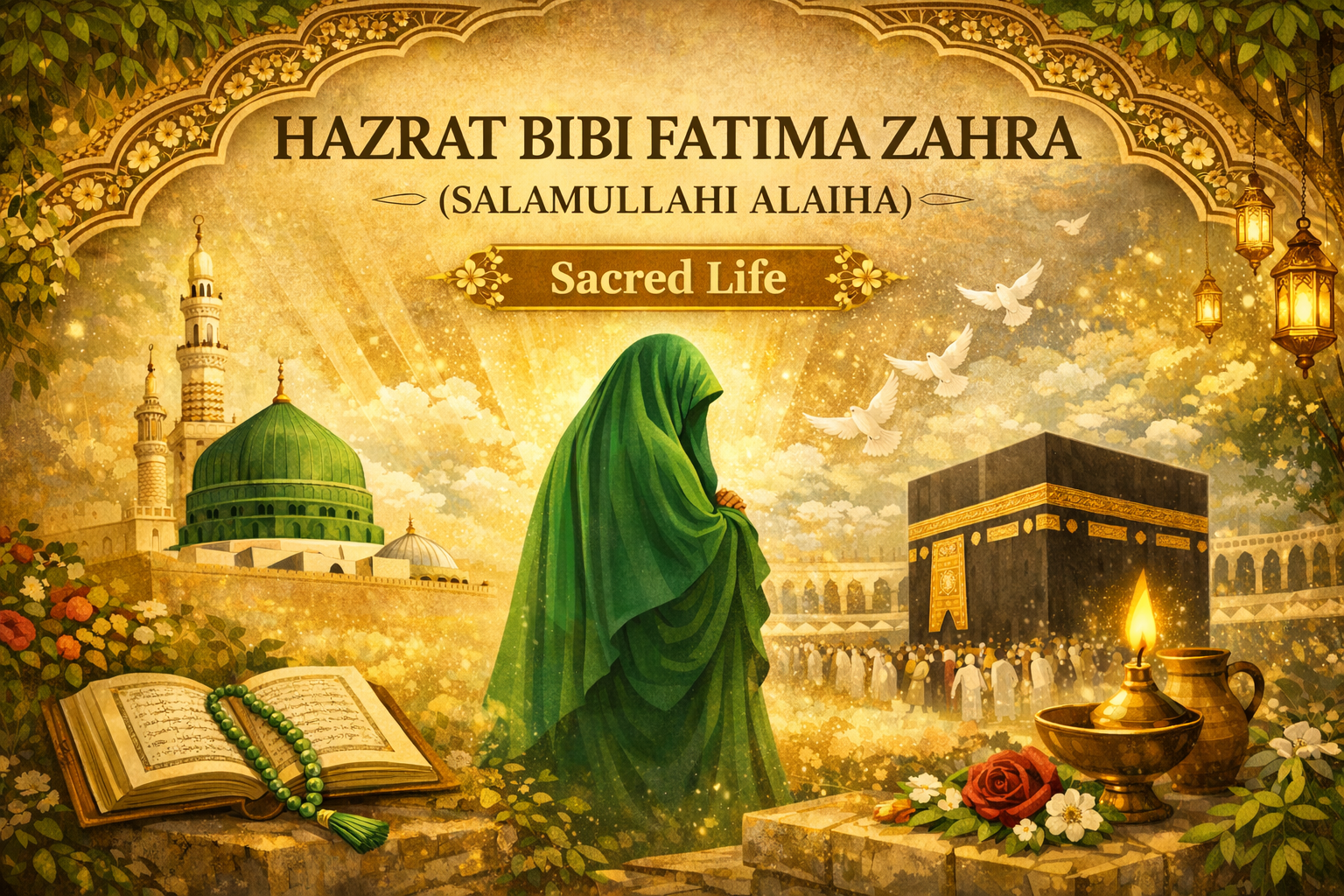
Sayyidatuna Khatun-e-Jannat, Noor-e-Nigah-e-Rahmatul-lil-‘Aalameen, Hazrat Fatimatuz Zahra (Salamullahi Alaiha)
Sayyidatuna Khatun-e-Jannat Hazrat Fatimatuz Zahra (Salamullahi Alaiha) is the most beloved and cherished daughter of Sayyiduna A‘la Hazrat, the Beloved Prophet Makki Madani (Sallallahu Alaihi Wasallam), and Sayyidatuna Ummul Mu’minin Hazrat Khadija (Radiyallahu Ta‘ala Anha).
Birth and Upbringing
Her blessed birth took place on 20th Jumada al-Thani, on a Friday, in Makkah al-Mukarramah.
After the demise of Hazrat Khadija (Radiyallahu Ta‘ala Anha), the Beloved Prophet (Sallallahu Alaihi Wasallam) entrusted her upbringing and care to Hazrat Fatima bint Asad (Radiyallahu Anha). When she too passed away, the Beloved Prophet (Sallallahu Alaihi Wasallam) entrusted her upbringing to Sayyidatuna Ummul Mu’minin Hazrat Umm Salama (Radiyallahu Anha).
Among her well-known titles are Zahra and Batool. Her famous kunyahs are Umm al-A’immah, Umm as-Sibtain, and Umm al-Hasanain.
The early upbringing of Hazrat Fatima Zahra (Radiyallahu Ta‘ala Anha) was personally undertaken by the Beloved Prophet (Sallallahu Alaihi Wasallam) and Hazrat Khadija (Radiyallahu Ta‘ala Anha). In addition, the earliest Muslim women also contributed to her nurturing. Her mother, Hazrat Khadija (Radiyallahu Ta‘ala Anha), passed away during her childhood. She witnessed the early days of Islam and endured all the hardships that the Beloved Prophet (Sallallahu Alaihi Wasallam) bore at the hands of the disbelievers in the initial period.
According to a narration, once the Beloved Prophet (Sallallahu Alaihi Wasallam) was in prostration at the Ka‘bah when Abu Jahl and his companions placed the entrails of a camel upon him. When Hazrat Fatima (Radiyallahu Ta‘ala Anha) came to know of this, she came and washed the blessed back of the Beloved Prophet (Sallallahu Alaihi Wasallam) with water, even though she was very young at that time. She was weeping, and the Beloved Prophet (Sallallahu Alaihi Wasallam) kept saying to her: “O comfort of your father! Do not weep, for Allah Ta‘ala is the Helper of your father.”
During her childhood, the event of Hijrah took place. Upon reaching Madinah al-Munawwarah, the Beloved Prophet (Sallallahu Alaihi Wasallam) sent Hazrat Zaid bin Harithah and Hazrat Abu Rafi‘ with 500 dirhams and a camel to bring Hazrat Fatima, Hazrat Fatima bint Asad, Ummul Mu’minin Hazrat Sawda, and Ummul Mu’minin Hazrat Aisha (Radiyallahu Anhum) from Makkah al-Mukarramah. Thus, they arrived in Madinah Tayyibah after some days. According to some other narrations, Hazrat Ali (Radiyallahu Ta‘ala Anhu) later brought them.
Until 2 AH, she remained under the care of Hazrat Fatima bint Asad. In 2 AH, when the Beloved Prophet (Sallallahu Alaihi Wasallam) married Ummul Mu’minin Hazrat Umm Salama (Radiyallahu Ta‘ala Anha), Hazrat Fatima was entrusted to her care.
Hazrat Umm Salama stated that when Hazrat Fatima was placed under her supervision, she intended to teach her manners, but by Allah, Fatima was more well-mannered than herself and knew all matters better than her.
Hazrat Imran bin Husayn narrates that once he was sitting with the Beloved Prophet (Sallallahu Alaihi Wasallam) when Hazrat Fatima, who was still young, came. Due to intense hunger, her complexion had changed. The Beloved Prophet said, “My daughter, come here.” When she came close, he supplicated: “O Sustainer who feeds the hungry! O Master who raises the lowly to heights! Remove the severity of hunger from Fatima.” After this supplication, the paleness of her face turned into redness, blood flowed in her face, and she appeared cheerful and healthy. Hazrat Fatima (Radiyallahu Ta‘ala Anha) herself stated that after that, she was never again troubled by severe hunger.
Marriage
According to some narrations, the Beloved Prophet (Sallallahu Alaihi Wasallam) said to Sayyiduna Amir al-Mu’minin Hazrat Ali (Radiyallahu Ta‘ala Anhu): “O Ali! Allah has commanded me to marry Fatima to you. Do you accept?” He replied, “Yes,” and thus the marriage took place. This narration is reported in authentic collections by Hazrat Abdullah ibn Mas‘ud, Hazrat Anas bin Malik, and Hazrat Umm Salama (Radiyallahu Anhum). Another narration from Hazrat Abdullah ibn Mas‘ud (Radiyallahu Anhu) states that the Messenger of Allah (Sallallahu Alaihi Wasallam) said: “Allah has commanded me to marry Fatima to Ali.” According to some narrations, Hazrat Ali (Radiyallahu Anhu) himself expressed his wish, and the Prophet accepted it.
The marriage of Sayyiduna Amir al-Mu’minin Hazrat Ali al-Murtada (Radiyallahu Anhu) and Sayyidatuna Khatun-e-Jannat Hazrat Fatimatuz Zahra (Radiyallahu Anha) took place on the 1st of Dhul Hijjah, 2 AH. Some other narrations from Sayyiduna Imam Muhammad al-Baqir and Sayyiduna Imam Ja‘far al-Sadiq (Radiyallahu Anhuma) mention that the Nikah was performed in Ramadan and the rukhsati in Dhul Hijjah of the same year.
For the marriage expenses, Hazrat Ali (Radiyallahu Ta‘ala Anhu) sold his armor for 500 dirhams to Sayyiduna Amir al-Mu’minin Hazrat Uthman Ghani (Radiyallahu Anhu), who later returned the same armor to him as a gift. The amount was handed over to the Beloved Prophet (Sallallahu Alaihi Wasallam) and was fixed as the mahr of Hazrat Fatima (Radiyallahu Ta‘ala Anha). According to some other narrations, the mahr was 480 dirhams.
For the dowry, the Beloved Prophet (Sallallahu Alaihi Wasallam) gave money to Hazrat Miqdad ibn Aswad to purchase items and sent Hazrat Salman al-Farsi and Hazrat Bilal (Radiyallahu Ta‘ala Anhum) to assist him. The items were presented before the Prophet (Sallallahu Alaihi Wasallam), and Hazrat Asma bint Umays (Radiyallahu Anha) was also present. The list of dowry items mentioned in various narrations includes: one shirt, one head covering (khimar), one black blanket, a bed made of date-palm leaves, two coarse mats, four small pillows, a hand mill, a copper vessel for washing clothes, a leather water skin, a wooden bowl for drinking water, a container made of date-palm leaves coated with clay, two earthen cups, an earthen pitcher, a piece of leather to spread on the ground, a white sheet, and a water pot. Seeing this simple dowry, the Beloved Prophet (Sallallahu Alaihi Wasallam) supplicated: “O Allah! Bless those whose best utensils are made of clay.” This dowry was purchased from the money obtained by Hazrat Ali (Radiyallahu Anhu) from selling his armor.
Some months after the Nikah, the rukhsati took place on the 1st of Dhul Hijjah. During the procession, Hazrat Fatima (Radiyallahu Ta‘ala Anha) rode a camel named Ashhab, led by Hazrat Salman al-Farsi (Radiyallahu Ta‘ala Anhu).
After marriage, she performed all household tasks herself and never uttered a word of complaint. She never demanded a servant. In 7 AH, the Messenger of Allah (Sallallahu Alaihi Wasallam) granted her a maid known as Hazrat Fidha. They arranged turns for work—one day Hazrat Fatima worked and the next day Hazrat Fidha.
Once the Messenger of Allah (Sallallahu Alaihi Wasallam) visited his daughter’s home and saw her grinding grain while holding a child in her lap. He said, “Assign one task to Fidha.” She replied, “Father, today is not Fidha’s turn.”
Her relationship with her husband Hazrat Ali (Radiyallahu Ta‘ala Anhu) was exemplary. She never demanded anything from him. Once, when she fell ill, Hazrat Ali asked if she desired anything to eat. She replied that her respected father had instructed her never to ask him for anything, lest he be unable to fulfill it and feel distressed. When Hazrat Ali insisted by oath, she mentioned pomegranate.
She witnessed several battles in which Hazrat Ali (Radiyallahu Ta‘ala Anhu) played a prominent role, yet she never wished that he should refrain from participating. In the Battle of Uhud, Hazrat Ali received sixteen wounds and the blessed face of the Messenger of Allah (Sallallahu Alaihi Wasallam) was also injured, but she showed no fear and attended to dressing wounds, treatment, and cleaning swords.
Allah Ta‘ala blessed her with two sons and two daughters: Sayyiduna Hazrat Imam Hasan (Radiyallahu Ta‘ala Anhu), Sayyiduna Hazrat Imam Husayn ibn Ali (Radiyallahu Ta‘ala Anhu), and daughters Hazrat Zaynab (Radiyallahu Ta‘ala Anha) and Hazrat Umm Kulthum (Radiyallahu Ta‘ala Anha).
The Beloved Prophet (Sallallahu Alaihi Wasallam) would call both her sons his own and loved them dearly. He said that Hasan and Husayn are the leaders of the youth of Paradise. Their names were also given by their grandfather, the Beloved Prophet (Sallallahu Alaihi Wasallam).
Hazrat Miswar ibn Makhramah (Radiyallahu Anhu) narrates that the Messenger of Allah (Sallallahu Alaihi Wasallam) said: “Fatima is a part of me; whoever angers her has angered me.”
Hazrat Abdullah ibn Zubayr (Radiyallahu Anhu) narrates that the Messenger of Allah (Sallallahu Alaihi Wasallam) said: “Indeed, Fatima is a part of me. Whatever hurts her hurts me, and whatever causes her hardship causes me hardship.”
Hazrat Abu Hanzalah (Radiyallahu Anhu) narrates that the Messenger of Allah (Sallallahu Alaihi Wasallam) said: “Indeed, Fatima is a part of me. Whoever harms her harms me.”
Hazrat Thawban (Radiyallahu Anhu), the freed slave of the Prophet, stated that whenever the Messenger of Allah (Sallallahu Alaihi Wasallam) intended to travel, the last person he would speak to before departing was Hazrat Fatima (Radiyallahu Ta‘ala Anha), and upon returning, the first person he would visit was also Hazrat Fatima (Radiyallahu Ta‘ala Anha).
Ummul Mu’minin Hazrat Aisha Siddiqah (Radiyallahu Ta‘ala Anha) narrates that before his blessed demise, the Messenger of Allah (Sallallahu Alaihi Wasallam) called Hazrat Fatima close and whispered something in her ear, upon which she began to weep. Then he whispered again, and she smiled. When asked the reason, she said that first her father informed her of his approaching demise, so she wept. Then he told her that she would be the first among his family to join him, so she smiled.
The blessed demise of the Beloved Prophet (Sallallahu Alaihi Wasallam) was a great calamity, heavy as a mountain, for Hazrat Fatimatuz Zahra, and six months after his demise, she too passed away.
Two months before her demise, she became severely ill. The wife of Sayyiduna Amir al-Mu’minin Hazrat Abu Bakr Siddiq (Radiyallahu Ta‘ala Anhu) cared for her and remained with her until the end, and she herself performed her ghusl.
Her funeral prayer was led by Sayyiduna Amir al-Mu’minin Hazrat Abu Bakr Siddiq Akbar (Radiyallahu Ta‘ala Anhu).
The date of her blessed demise was 3rd Ramadan, 11 AH. She is buried in Jannat al-Baqi‘, where a shrine had been built, which was demolished by the Saudi government on 8th Shawwal, 1344 AH.
Presented by
Syed Muhammad Intisab Husain Qadiri Ashrafi Madari
Sajjada Nashin, Astana-e-Aaliya Qadiriya, Huzoor Mujaddid Moradabadi